My Doberman Has a Conspiracy Board. Here's What He's Teaching Me About AI and Social Media.
Two dogs, a suspicious pigeon, and an AI-powered comedy series. Here's how we're experimenting with character-driven storytelling and social media marketing.

How two dogs, a little imagination, and AI became an experiment in character-driven storytelling.
By Melanie Brown | Bluedobie Developing
I never expected to find myself producing a congressional hearing for a Doberman Pinscher.
But here we are.
It started with a pigeon.
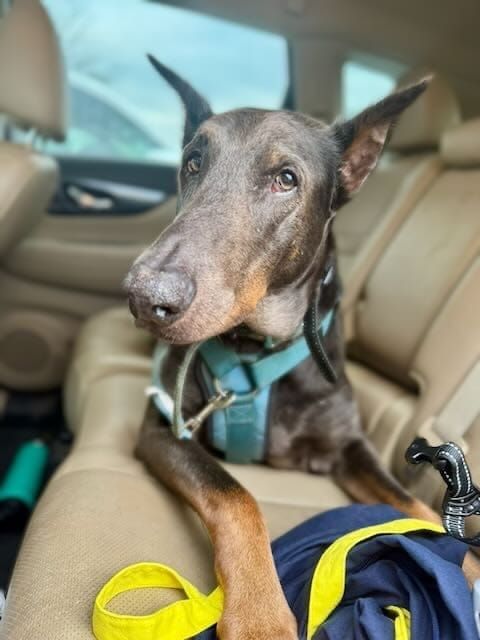
Well, technically, it started with my blue Doberman, Sabre, and his ongoing belief that absolutely everything happening around our house requires his personal investigation.
Sabre takes his responsibilities seriously. Very seriously.
A bird flying over the yard? Suspicious.
Someone pulling into the driveway? Security alert.
An unexpected noise? Immediate investigation.
He's eleven and a half years old, and apparently retirement isn't in his vocabulary.
So when we started experimenting with AI-generated storytelling for social media, I already had the perfect character.
I just didn't realize he was about to uncover an international conspiracy.
The Pigeon That Started Everything
Our first real storyline became known as Bird 51.
The premise was simple: Sabre spotted something flying overhead and decided it wasn't an ordinary bird.
Naturally, an investigation followed.
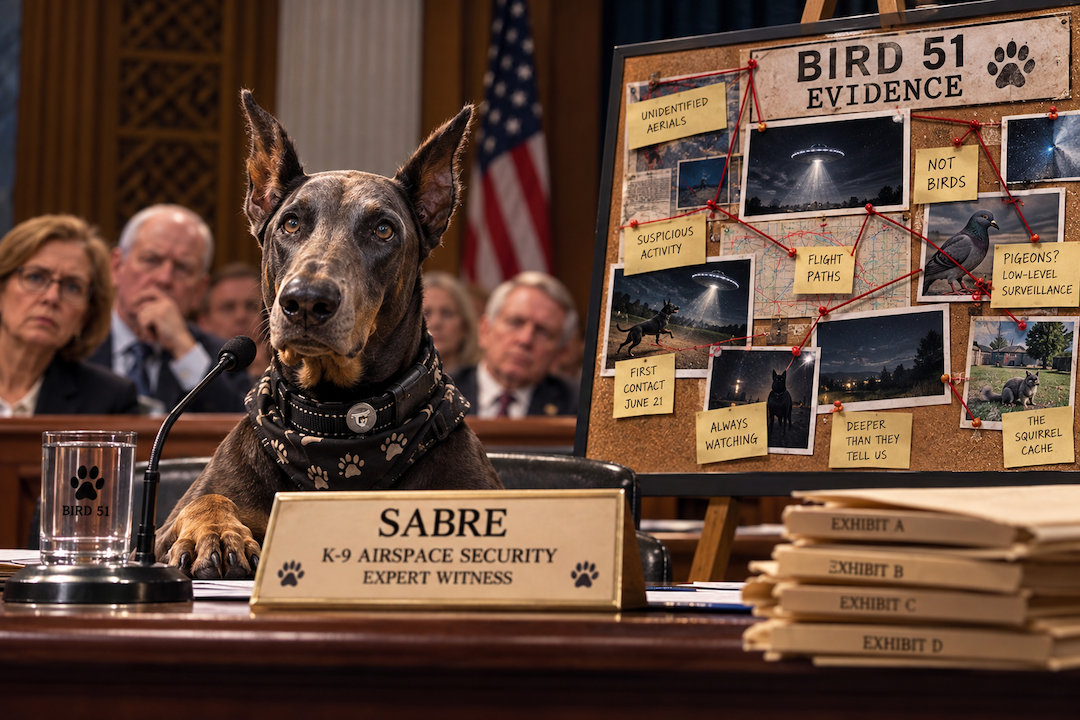
Before long, we had a conspiracy board complete with photographs, connecting strings, and enough questionable evidence to make a detective reconsider his career choices.
Then things escalated.
Sabre eventually found himself testifying before Congress as a K-9 Airspace Security Expert Witness.
Yes, Congress.
Over a pigeon.
And somewhere along the way, somebody shared his conspiracy board post on Facebook.
That share caught my attention.
Not because one share means we've suddenly cracked the social media algorithm. It doesn't.
But because someone saw this ridiculous fictional investigation and decided somebody else needed to see it.
For a small business owner who spends a considerable amount of time thinking about marketing, that's worth paying attention to.
It also made me wonder whether we were onto something bigger than a few funny dog videos.
🚨 Follow Sabre's Investigations
The conspiracy board was only the beginning.
Follow Sabre the Blue Dobie as he investigates suspicious wildlife, unexplained household disturbances, and threats to national security that everyone else insists are perfectly ordinary.
Catch his ongoing adventures on Facebook, Instagram, and TikTok.
The investigation remains open.
Sabre 🐾💙
Chief of Household Security
The Characters Were Already There
Here's something important about how we're using AI.
AI didn't invent Sabre's personality.
I've lived with that personality for more than eleven years.
He's protective, dramatic, opinionated, and convinced that the household cannot possibly function without his supervision.
We simply took the behaviors we already knew and exaggerated them into comedy.
And then there's Zeke.
Zeke is our older Rottweiler and a retired service dog. He's experienced, observant, and considerably less impressed by nonsense.
Where Sabre sees a potential national security emergency, Zeke wants to know one thing:
Is Daddy safe?
That's Anthony, my husband.
In our fictional universe, Sabre might announce that he's discovered an elaborate conspiracy involving unidentified flying objects.
Zeke's response is essentially, “Son, you don't declare an invasion because something flew over the fence.”
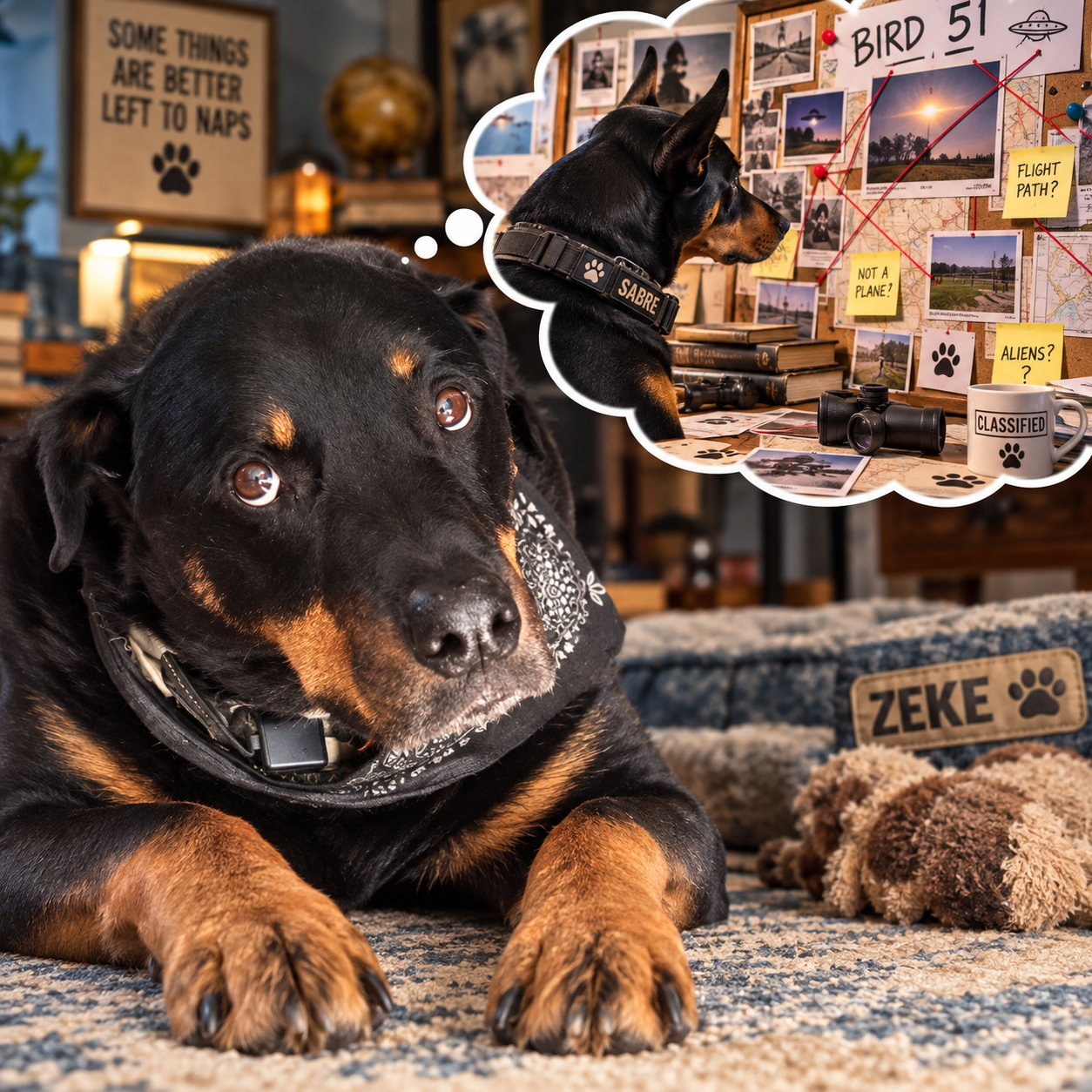
Their personalities give us two very different perspectives on the same situation.
Sabre creates the crisis.
Zeke questions whether there was ever a crisis to begin with.
And because those personalities are based on the dogs we actually know, we don't have to reinvent the characters every time we create something new.
We already understand how they would react.
That's the foundation of character development, whether you're writing a novel, producing a television series, or creating social media content about two dogs.
🐾 Follow Zeke's Side of the Story
Every investigation has two sides.
Sabre may be convinced he's protecting the household from suspicious pigeons, unexplained earthquakes, and questionable squirrel activity.
Zeke, our retired service dog, has a slightly different perspective.
He's seen enough excitement in his lifetime to know that not everything requires a congressional hearing.
Follow Zeke the Old Man Rottie on Facebook and Instagram for his commentary on Sabre's latest investigations.
Because somebody has to be the voice of reason.
And somebody has to make sure Daddy's safe.
-Zeke 🐾💙
Then Came the Couchquake
One evening, my AI writing partner and I were laughing about the Bird 51 storyline.
And I mean really laughing.
The kind of laughing where you can't get words out, tears are running down your face, and the couch is physically shaking.
Sabre was lying beside me.
He moved approximately one inch.
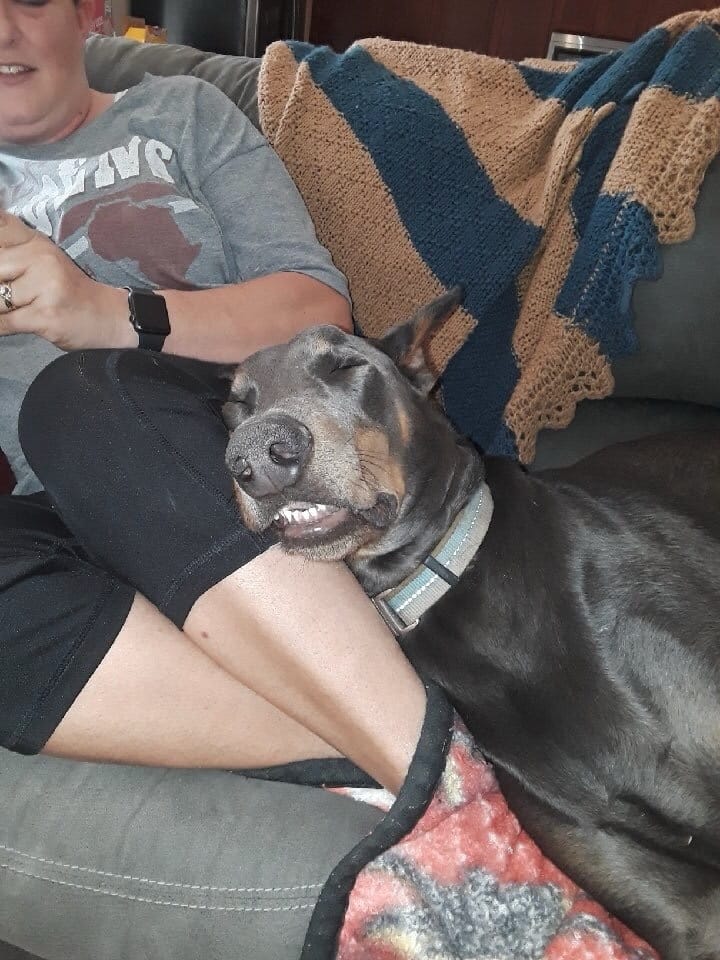
Then he went back to sleep.
Naturally, this became another incident requiring investigation.
We called it Case #404: The Couchquake.
Sabre's version became a three-part investigation into an unexplained seismic event originating from the couch.
Zeke's version, The Gigglequake, offered a considerably less dramatic interpretation.
His conclusion?
“He calls it a security incident. I call it Tuesday.”
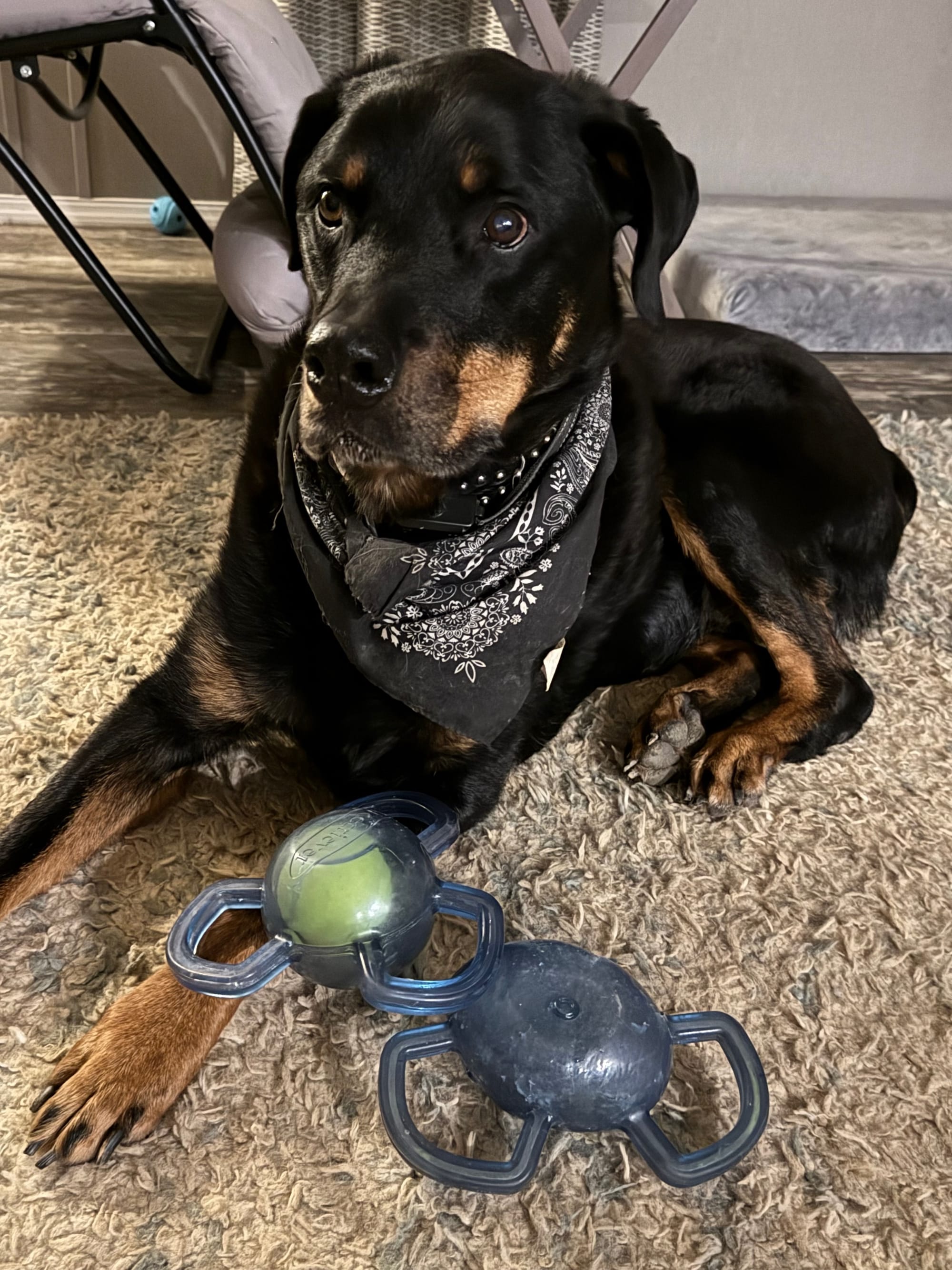
We had created two connected stories about the same event, each told from a different character's perspective.
And that's when I started looking at what we were doing a little differently.
We weren't simply generating individual social media posts anymore.
We were building a recurring fictional world.
What AI Actually Does in This Process
There's a lot of discussion about using AI to create social media content.
Usually, the conversation focuses on efficiency.
Write captions faster. Generate more posts. Create graphics. Automate the schedule.
Those things can be useful, particularly for small business owners who don't have an entire marketing department.
But efficiency isn't what makes our dog stories interesting.
The creative collaboration is.
I bring the personalities, the real-life incidents, the humor, and the direction.
AI helps me explore possibilities.
What if Sabre treated a pigeon like a national security threat?
What if he had to testify before Congress?
What would Zeke say about that?
What happens when we tell the same story from both dogs' perspectives?
From there, we develop the dialogue, visual concepts, episode structure, and supporting content.
AI also helps us create images and videos that would be difficult or expensive to produce traditionally.
I'm not renting a congressional hearing room so my Doberman can testify about suspicious pigeons.
And I'm certainly not asking an actual squirrel to sign a talent release.
AI makes those ridiculous creative ideas possible.
But the technology doesn't know my dogs the way I do.
It doesn't automatically understand why Zeke's reaction should be understated or why Sabre would consider moving one inch during a household disturbance an adequate security response.
That knowledge comes from me.
AI helps bring the story to life. It doesn't replace the person who knows what story is worth telling.
Why We're Experimenting With a Series Instead of Random Posts
Social media can be frustrating for small businesses.
You create something, publish it, and hope people see it.
Then you do it again tomorrow.
And the next day.
It's easy to fall into a cycle of producing individual pieces of content without giving people much reason to remember what came before.
Our experiment takes a different approach.
Instead of treating every post as a standalone event, we're developing connected episodes.
Sabre has his investigations.
Zeke has his responses.
The characters maintain consistent personalities, and the stories build on situations the audience may already recognize.
Someone who sees the first episode might be curious about what happens next.
Someone familiar with Sabre might anticipate another completely disproportionate response to an ordinary event.
And someone following both accounts might enjoy seeing Zeke dismantle Sabre's latest theory.
That's the idea, anyway.
We're testing it rather than assuming it works.
We've scheduled approximately three weeks of connected content across Facebook, Instagram, and TikTok, with the two dogs' stories appearing on their respective accounts.
The scheduling is intentional, too.
We want the audience to have an opportunity to encounter the original situation before seeing the reactions and follow-up episodes.
We're also considering each platform's recommended posting times rather than assuming the same schedule works everywhere.
It's a small experiment, but it's a structured one.
What We're Actually Measuring
I don't want to confuse creating entertaining content with creating effective marketing.
Those are related goals, but they aren't identical.
A funny video might attract attention without convincing anyone to follow the account.
A post might receive a lot of views without generating a meaningful interaction.
And a series might entertain existing followers without reaching anyone new.
So we're watching more than view counts.
We're interested in whether people share the content, leave comments, follow the accounts, and engage with later episodes.
We're also looking for signs that people recognize the recurring characters.
Do they respond to Sabre as a character?
Do they start anticipating Zeke's commentary?
Does interest continue beyond the first episode?
Those questions matter more to me than declaring victory because one video received a certain number of views.
We have one encouraging early signal from the shared conspiracy board post.
That's a start.
It isn't a conclusion.
And I think being honest about that is important, especially when we're discussing AI and marketing.
There's already enough exaggerated certainty surrounding both subjects.
We don't need to add to it.
What This Means for Small Businesses
Now, I know what some of you are thinking.
That's entertaining, Melanie, but I don't have two dogs with competing intelligence departments.
Fair enough.
Most businesses don't.
But you probably have something just as valuable.
You have experiences, personalities, stories, and perspectives that make your business different from the one down the road.
Maybe you're a cleaning business with stories about the unexpected things that happen on the job.
Maybe you're a contractor who can explain common homeowner mistakes through a recurring fictional character.
Maybe you're a baker who has spent years watching customers debate which dessert deserves first place.
Or maybe you're an author who wants to introduce readers to the personalities and world behind a book.
You don't have to turn your business into a comedy series.
You don't even have to use fictional characters.
The larger idea is to give your audience something recognizable and worth returning for.
That might be a recurring educational series, a behind-the-scenes feature, a familiar voice, or a story that develops over several posts.
The important part is that it fits your business and the people you're trying to reach.
A recurring format can also make content planning easier.
Once you understand the structure, you don't have to start from a blank page every time.
You have a foundation to build on.
And for business owners who are already juggling customers, finances, scheduling, and everything else, that matters.
There's Still a Human Behind the Curtain
I think one of the biggest mistakes businesses can make with AI is assuming that generating more content automatically means creating better content.
It doesn't.
You can produce fifty generic posts in the time it once took to write five.
But if none of those posts sounds like you, reflects your business, or gives your audience something useful, what have you accomplished?
You've filled a calendar.
That's not necessarily the same thing as building a connection.
Our Sabre and Zeke stories work creatively because I know the characters.
I know what makes them funny.
I know when a line doesn't sound right.
And I know when an idea has gone from entertainingly ridiculous to simply not making sense.
AI can suggest ten different directions.
I still have to decide which one belongs in the story.
The same principle applies when I use AI for Bluedobie Developing.
The tools can help with research, organization, writing, technical work, and content development.
But they don't replace understanding the business, its customers, or what the owner is trying to accomplish.
That's where human judgment comes in.
And it's where I think the most useful applications of AI begin.
Three Weeks, Two Dogs, and One Very Questionable Pigeon
By the time our experiment finishes, we'll have a better idea of whether serialized, character-driven content is something our audience wants more of.
Maybe we'll discover that people love the ongoing storylines.
Maybe certain platforms will respond better than others.
Maybe Zeke's deadpan commentary will outperform Sabre's elaborate investigations.
I'm not making predictions.
I'm collecting evidence.
And when the three weeks are over, I plan to look at the results and share what we learned.
Not just the successful posts.
The ones that didn't perform as expected, too.
Because that's how a useful marketing experiment should work.
You try something, measure what happens, and use that information to decide what comes next.
In the meantime, I'm having an unreasonable amount of fun producing fictional investigations for a blue Doberman who already believes he's in charge of household security.
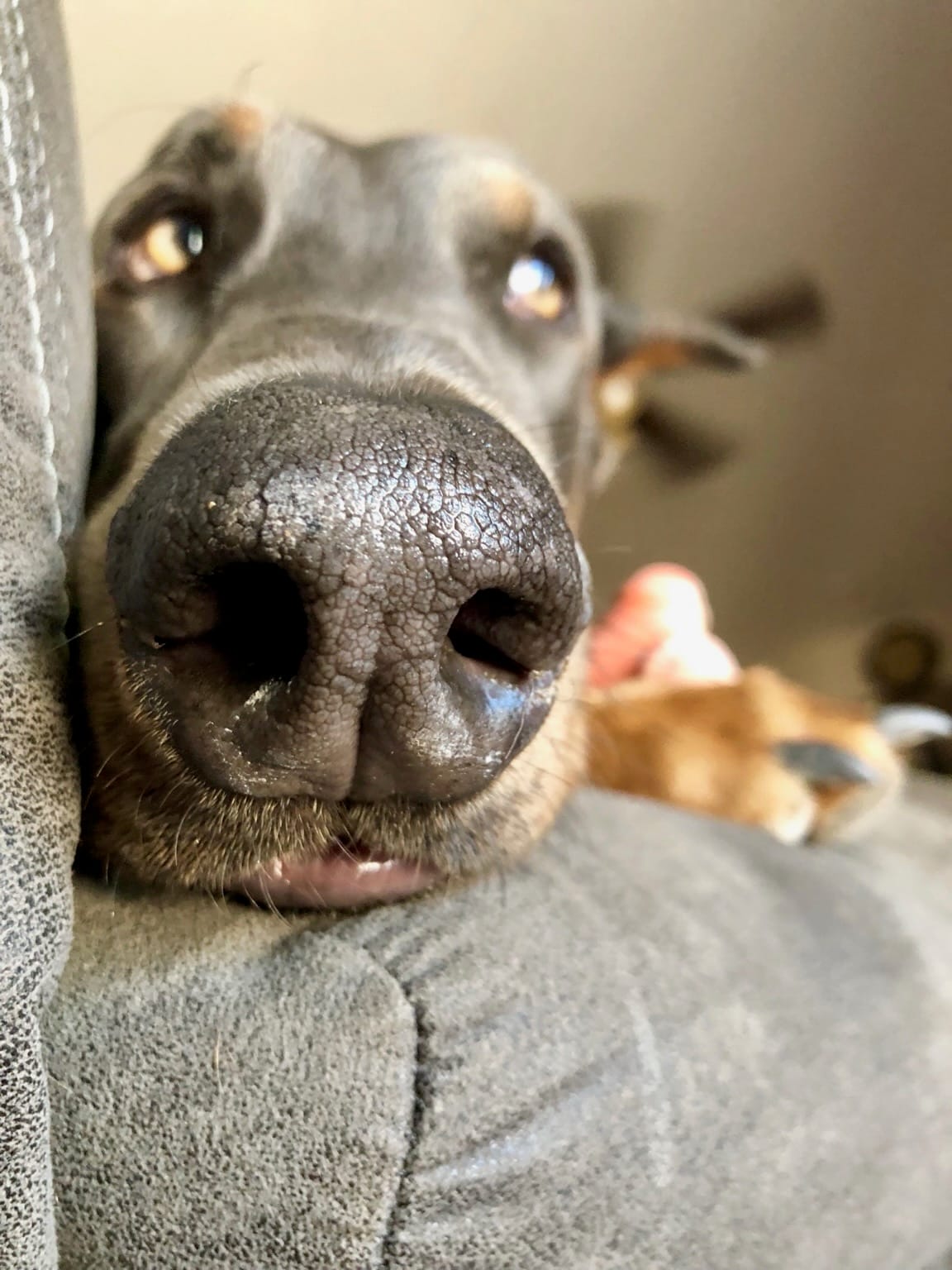
And I've learned something I think is worth sharing.
Sometimes the most interesting use of AI isn't asking it to create something for you. It's using it to develop an idea that only you could have brought to the table.
For me, that idea happened to involve a pigeon, a conspiracy board, and a Doberman testifying before Congress.
I never said marketing experiments had to be normal.
And if Sabre has anything to say about it, the investigation is far from over.
Melanie Brown is the founder of Bluedobie Developing, a rural Kentucky-based SaaS and web development company, and the creator of DobieCore - an AI content platform engineered to give small business owners professional results without the prompt engineering learning curve. She writes the Bluedobie Dialogues series about systems thinking, sustainable business architecture, and what durability actually looks like in practice.
If you'd like to support the writing, you can buy me a coffee here.