
About
I build things for the fifty-percent day.
Not launch day. Not the good week when the calendar cooperates and the logic is obvious. The ordinary Tuesday, with a migraine sitting behind one eye and the work still due.

The assumption that breaks everything
Most systems get designed during a good stretch. That is the problem, and it is nearly invisible while it's happening. You're rested, the structure feels obvious, the workflow runs beautifully. Of course it will hold.
Then a bad week arrives, and the system doesn't fail loudly. It just quietly begins requiring more than you have.
I learned this the expensive way. I was mid-build on a large Shopify project when silent migraines put me in the hospital. The project hadn't been planned badly. It had been planned around a version of me who was always available — and that woman, it turns out, is not a reliable dependency.
The 50% Capacity Rule
If a process collapses at half capacity, it isn't durable. It's a mood.
- A website should be navigable by someone tired, distracted, and standing in a parking lot. If it needs a guided tour, it was organized for its owner.
- Automation should protect cognitive bandwidth, not hand you another dashboard to babysit.
- An AI system has to be allowed to say I don't know. A model that was never given permission to stop will invent a category on row eleven and never mention it.
Bluedobie Developing — the business side — got restructured around the same rule. Shorter engagements. Fewer moving parts. Nothing that requires me at my best in order to stay upright.
Why there's a memoir here
People occasionally ask why a memoir about bipolar disorder shares a masthead with articles on information architecture.
It's the same subject.
I did not arrive at capacity-aware design through a framework. I arrived at it through fifteen years of building a life that had to keep running on the days I couldn't. Military moves. A diagnosis that took far longer than it should have. Whole seasons where the most ambitious available goal was staying upright. The Woods Behind Me is that account, written in chapters — set down when it gets sharp, picked back up when there's more perspective to work with.
The technical writing is what I decided. The memoir is why. Neither one explains much without the other.
What I'm not
Not a productivity influencer. Not a growth consultant. Not someone who thinks the answer to a hard season is a better morning routine. I don't write to impress — I write to clarify, and generally only after I've stopped being angry about the thing.
The dog
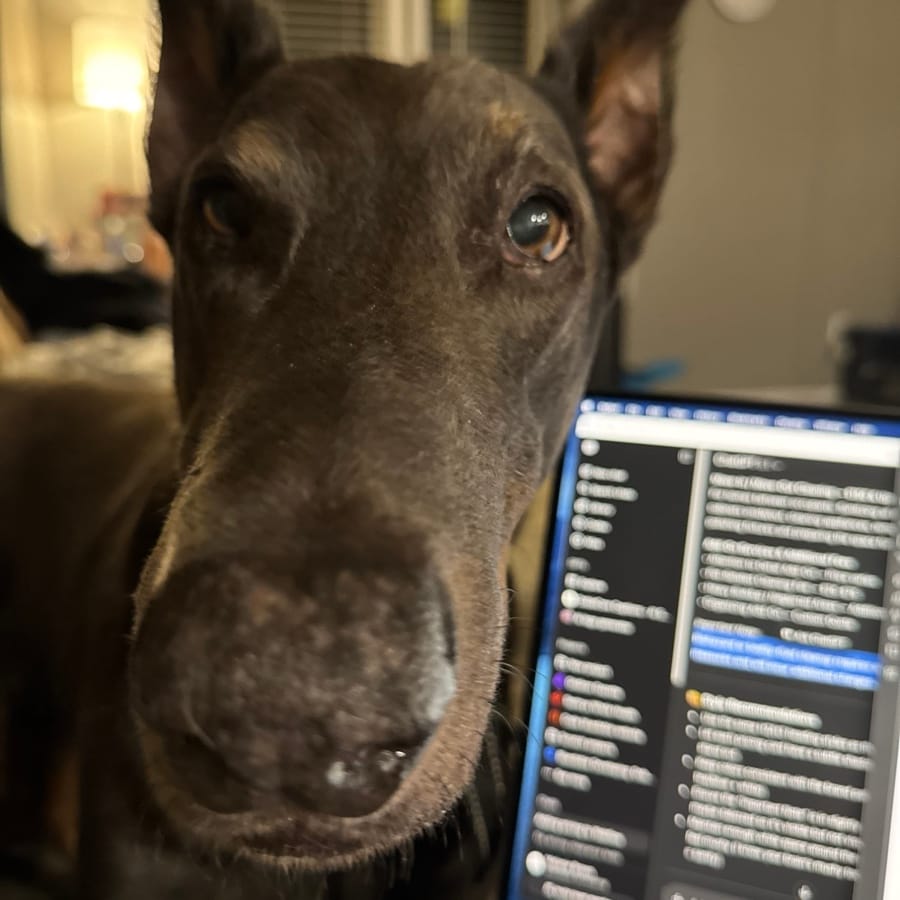
Sabre is a blue Doberman and my unofficial office manager. He has been present for every deadline, every rebuild, every late deploy, and every hospital scare of the last several years. He's in the logo because he earned it.
Elsewhere
I run Bluedobie Developing, LLC out of Princeton, Kentucky — websites and practical AI tooling for small businesses that don't have a department for any of it. If something here describes a problem you're actually having, that's where the work happens.
Notice where your systems fail at fifty percent. That's the real design brief.