The Website Was Never the Finish Line: What Too Good Maids Taught Me About Building for Growth
Two years later, Too Good Maids is still growing. The website was never the finish line. It was part of the digital foundation that helped a rural business become easier to find, trust, and grow.

Two years ago, I wrote about the importance of an online presence for rural small businesses.
At the time, Too Good Maids was one of the examples.
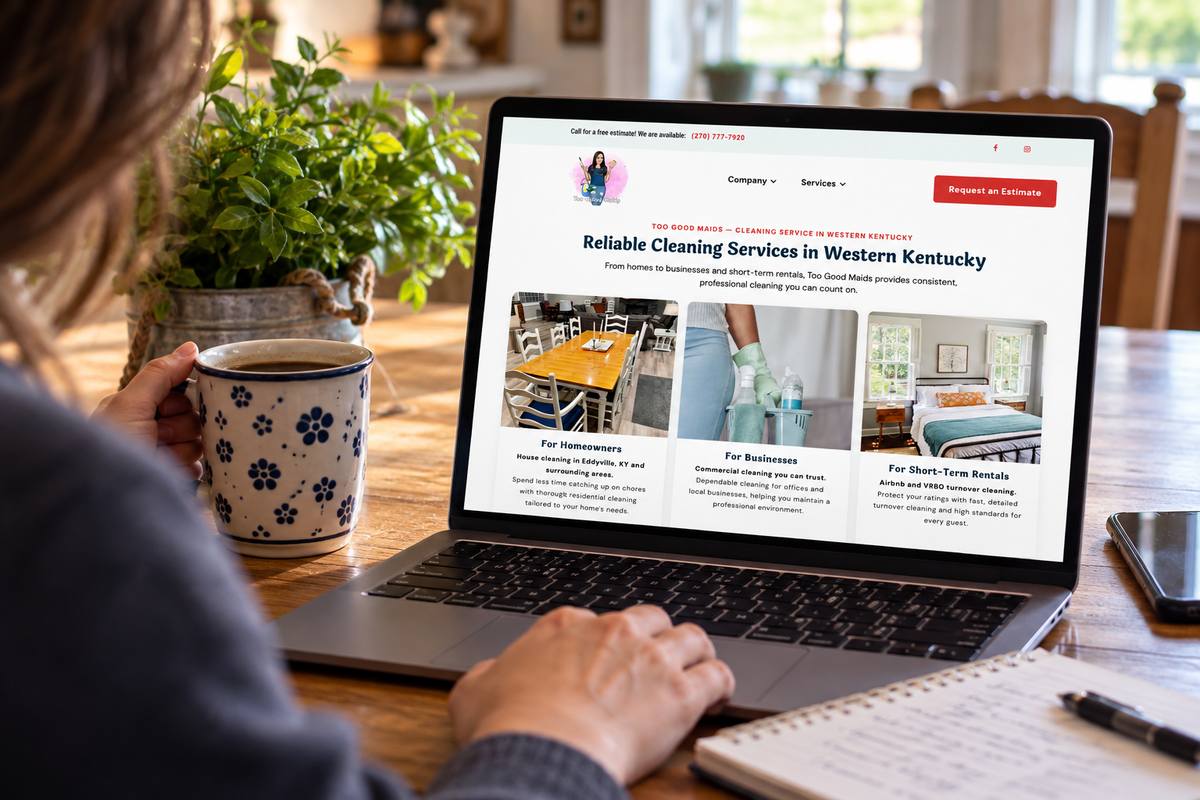
Bluedobie Developing had built the company a website, worked on its search visibility, and helped establish the digital foundation around a growing cleaning business here in western Kentucky.
Two years later, I can tell you something more useful than a list of statistics about why small businesses need websites.
Too Good Maids is still growing.
In fact, the owner has had to hire at least three additional employees to keep up with the workload.
That changes the story.
Because the website was never really the point.
Rural businesses do not need to look bigger. They need to be easier to find.
There is a persistent assumption that rural businesses are limited by geography.
Sometimes they are. There are fewer people driving past the storefront. Word of mouth travels quickly, but only so far. The customer base is smaller, and traditional advertising can become expensive long before it becomes effective.
But geography works differently online.
A cleaning company does not need the entire internet to find it. It needs the right person, in the right service area, looking for a cleaning company to be able to find it, understand what it offers, and decide whether to make contact.
That distinction matters.
Current consumer behavior makes the point fairly clearly. In BrightLocal's 2026 research, 84% of U.S. consumers said they had searched online for a local business within the previous three months. Most of those searches are not leisurely research projects, either. Consumers usually decide which local business to use in under 30 minutes, and 72% consider three businesses or fewer before making that decision.
Source: BrightLocal, Consumer Search Behavior Study 2026
Being online does not guarantee that a business will win that decision.
It does mean the business gets a chance to be considered.
That is the first job of a digital presence.
A website is infrastructure, not decoration
I build websites, so it would be convenient for me to tell you that a website fixes everything.
It doesn't.
A beautiful website that nobody can find is decoration.
A website that looks good on a laptop but is miserable to use from a phone creates friction exactly where a local customer is most likely to encounter it. In BrightLocal's 2026 consumer research, 73% of respondents said their most recent local business search started on a mobile phone.
Source: BrightLocal, Consumer Search Behavior Study 2026
Worldwide web usage tells much the same story. Mobile devices accounted for 58.96% of worldwide web traffic in September 2026.
Source: StatCounter Global Stats
That means mobile design is no longer the smaller version of the website you worry about after the desktop version is finished.
For many customers, it is the website.
And the website itself is only one part of the system.
People move between search results, Google Maps, reviews, websites, and social media while deciding whether they trust a business. In 2026, 75% of consumers used more than one channel during their most recent search for a local business. Google Search remained the most common starting point, but social media, maps, review sites, and even AI tools were part of the same research process.
Source: BrightLocal, Consumer Search Behavior Study 2026
The pieces reinforce one another.
Your website tells someone what you do. Your Google Business Profile helps them find you. Reviews provide evidence that other people trusted you first. Social media can show that the business is alive, active, and human.
None of those pieces needs to be elaborate.
They need to agree.
Trust is built before the phone rings
One of the things that has become clearer since I originally wrote about this is how much online visibility is really about reducing uncertainty.
Someone looking for a house cleaner is not simply searching for "cleaning."
They are deciding who they are willing to let into their home.
That is a different problem.
They want to know whether the company is legitimate. They want to see what other customers have experienced. They want basic information without having to hunt for it. They may look at the website, leave, check reviews, look at Facebook, go back to Google, and then return to the website before ever making contact.
That behavior is increasingly measurable.
BrightLocal found that only 6% of consumers simply clicked the top local search result. People were looking at proximity, star ratings, number of reviews, completeness of business information, pricing, and photos before choosing.
Source: BrightLocal, Consumer Search Behavior Study 2026
Its 2026 review research found something else I think matters: after reading a positive review, 66% of consumers continued researching rather than immediately buying or booking. The most common next destination was the business's website, visited by 54% of consumers.
Source: BrightLocal, Local Consumer Review Survey 2026
That is why I don't think of a website as a digital business card.
It is part of the trust architecture around the business.
Then Too Good Maids kept growing
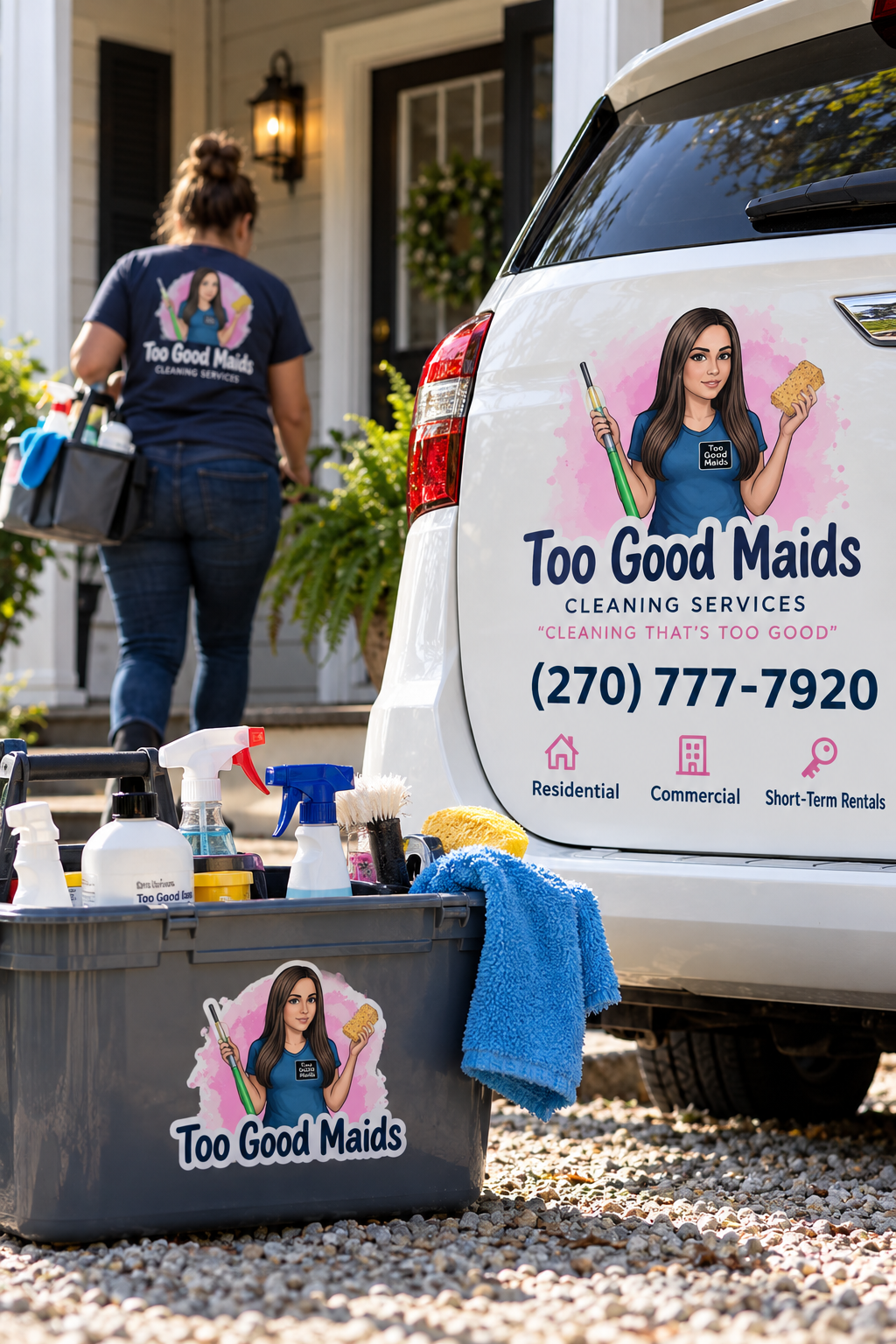
This is the part I couldn't have written two years ago.
When we first worked on Too Good Maids' online presence, the goal was visibility. Build the website. Make the company easier to find. Give potential customers somewhere credible to land when they searched.
The early results were encouraging.
But early traffic is not the same thing as a durable business.
Two years later, Too Good Maids is thriving. The workload has grown enough that the owner has had to hire at least three additional employees to keep up.
I want to be careful about what I claim here.
A website did not hire those employees.
SEO did not clean a single house.
A Google listing did not deliver good service, earn a customer's trust, answer the phone, manage a schedule, or do the thousand small things required to turn a local service business into one that people recommend.
The owner did that.
What the digital system did was remove one of the constraints around that work: being found.
That is the part good technology is supposed to do.
It should not replace the thing a business is good at. It should make it easier for that work to reach the people who need it.
Growth changes the problem
There is another side to this that does not get talked about enough.
Visibility is a good problem until the business cannot absorb any more of it.
Once inquiries become customers, and customers become recurring workload, the bottleneck moves.
Now the problem may be staffing.
Scheduling.
Communication.
Payments.
Keeping business information accurate across multiple places.
Responding to leads while still doing the actual work.
Making sure the owner is not carrying the entire operating system of the company around in her head.
That is why I have become less interested in building individual digital things and more interested in how those things work together.
Growth exposes weak architecture.
If every additional customer requires proportionally more administrative work from the owner, eventually growth starts consuming the capacity it was supposed to create.
A durable business needs enough structure underneath it to absorb success.
You do not have to build everything at once
This is especially important for small rural businesses because budgets are real.
Most of the businesses I work with are service businesses. They are not trying to build enormous online stores or complicated digital ecosystems. They need people to find them, understand what they do, trust them enough to make contact, and have an easy way to take that next step.
That does not require seventeen social platforms, six automation tools, and an AI strategy because somebody on LinkedIn said it was the future.
Start with the constraint.
If people cannot find you, work on visibility.
If they find you but do not contact you, look at trust, usability, messaging, and the path to contact.
If customers are arriving but administration is eating the owner's day, the problem has moved from marketing to operations.
The technology should follow the business problem, not the other way around.
There are plenty of ways to build that foundation at different price points. DIY website builders can be perfectly reasonable for some business owners, but the real calculation involves more than whether you can figure out how to put a page together.
It takes time to build and maintain a website. It takes enough technical comfort to handle domains, forms, mobile layouts, integrations, updates, and the inevitable moment when something that worked yesterday suddenly decides it has other plans.
Then there is the part that is easier to overlook: you still have to know how to make the website work for the business.
That means understanding what your customers are searching for, how they move through the site, what information they need before they are willing to contact you, how local search works, where calls to action belong, and how the website connects to your Google Business Profile, reviews, and the rest of your online presence.
Being able to build a website and being able to build an effective website are not quite the same skill.
For some owners, learning all of that makes sense. They have the time, interest, and technical comfort to do it well. For others, every hour spent figuring out SEO, troubleshooting a contact form, or trying to understand why the mobile menu has wandered off into the wilderness is an hour they are not spending on the work that actually makes their business money.
That is where the cost calculation changes.
Professional help makes sense when the cost of learning, building, maintaining, and marketing the website yourself becomes greater than the cost of having someone else handle that part of the system.
Neither approach is inherently more legitimate.
The goal is not to prove that you can build your own website.
The goal is to build a system that helps the business work.
The internet did not eliminate geography. It changed what geography means.
Rural businesses still operate under real constraints. Connectivity itself remains part of the rural economic conversation. The USDA continues to treat broadband as important infrastructure for rural communities and businesses, including their ability to reach markets and participate in the broader economy.
Source: USDA Rural Development, Broadband
But a rural address does not have to mean digital invisibility.
Too Good Maids did not need millions of impressions.
It needed to be visible to people in western Kentucky who needed a cleaning service.
Then it needed to do good work when they called.
Two years later, the most interesting result is not a traffic graph. It is not a search ranking. It is not a percentage in an analytics dashboard.
It is three additional people needed to help carry the workload.
That is the part worth measuring.
A good digital presence does not manufacture a good business.
It gives a good business more room to be found.
And sometimes, if the business behind it is strong enough, the next problem becomes figuring out how to keep up.
If your website, content workflow, or business systems feel harder than they should, Bluedobie Developing helps small businesses build calmer, more durable digital foundations.
Start with the piece that keeps creating friction. That is usually where the system is asking to be redesigned.
Melanie Brown is the founder of Bluedobie Developing, a rural Kentucky-based SaaS and web development company, and the creator of DobieCore, an AI content platform engineered to give small business owners professional results without the prompt engineering learning curve. She writes the Bluedobie Dialogues series about systems thinking, sustainable business architecture, and what durability actually looks like in practice.
If you enjoyed this piece and would like to support our work, please buy me a cup of coffee here.