
Your Best Day Is Lying to You
Why I stopped letting the most optimistic version of me run the whole operation.
If you are unable to read this article in its’ entirety, please click here.
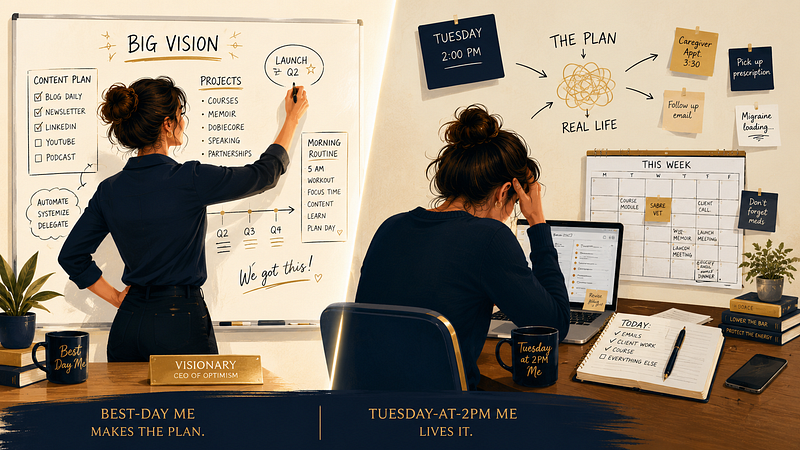
Every few months, a highly motivated woman appears in my life and completely wrecks my schedule.
She creates ambitious workflows. She reorganizes projects. She signs me up for things. She decides we are going to exercise more, write more, automate more, organize more, and generally become a superior life form by approximately Thursday.
Unfortunately, that woman is me.
Specifically, she is Best-Day Melanie.
Meet Best-Day Melanie
You probably know her. Or at least your version of her.
Best-Day Melanie slept well. She has energy. No migraine is quietly assembling itself behind her left eye. The tremor in her hands is cooperating. There is no family crisis pending, no surprise appointment on the calendar, no emotional landmine she forgot was buried in the yard.
She is unstoppable.
She is also wildly unrealistic.
The problem is not that she shows up. The problem is what she does when she gets here. She sits down with her full complement of ambition and optimism and builds systems that assume she will be present every day to run them. She commits to daily posting schedules and aggressive project timelines and early morning routines that require eight hours of sleep and no migraines and a complete absence of the kind of weeks that just happen sometimes.
Then she leaves.
And the rest of us have to live inside whatever she built.
The Problem Is Not Motivation
Most people assume that when a system breaks down, the culprit is motivation. You wanted it enough at the beginning and then you stopped wanting it. Character flaw. Personal failure. Try harder.
That is rarely what is actually happening.
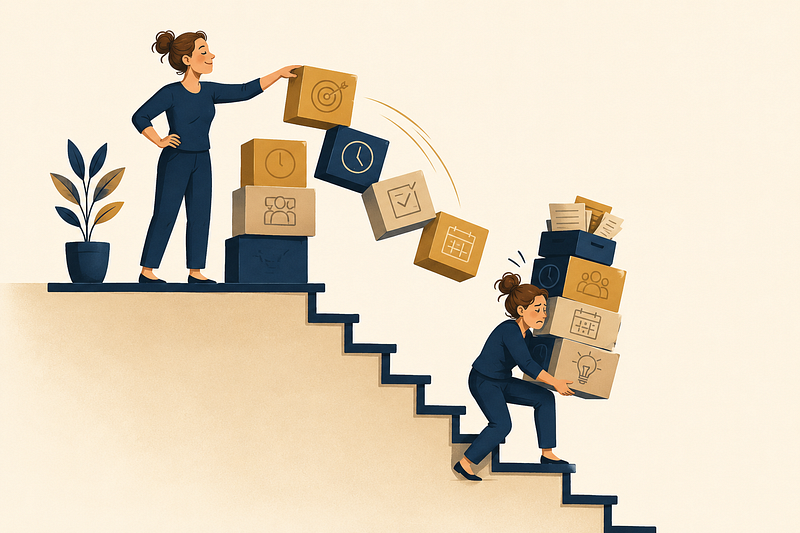
The real problem is simpler and more structural: plans get created under one set of conditions and executed under another. Best-Day You builds the system. Average-Day You has to live inside it.
Those are not always the same person. They do not have the same capacity, the same energy, or the same tolerance for friction. And a system that requires the best version of you to show up every day in order to keep running is not a durable system. It is a performance.
Performances require something from you every time the curtain goes up. Systems should not.
The Tuesday at 2 PM Test

I started applying a simple framework to every workflow and commitment I consider: Would Tuesday-at-2-PM Me be able to do this?
Not Vacation Me, who feels rested and inspired and has temporarily forgotten what her workload looks like. Not Fresh-Start Me, who appears reliably at the beginning of every new month with inexplicable confidence. Not January-1st Me, who has never once followed through on the things she announces in January. Not Just-Finished-A-Course Me, who is briefly convinced that everything is about to change.
Just Tuesday at 2 PM. The ordinary version. The one paying the bills. The one who has already answered twelve emails and made four decisions and is starting to feel the afternoon lag while something else pings in the background.
If Tuesday-at-2-PM Me can do this, it belongs in the system.
If it only works for Best-Day Me, it is an aspiration. That is fine — aspirations have a place. They just do not belong in the operating workflow.
Capacity Is Not Constant
Most productivity advice is written as though humans are a stable operating system. Consistent inputs, predictable outputs, upgradeable with the right habits.
We are not.
Capacity fluctuates. For everyone, but significantly more for people managing chronic illness, caregiving responsibilities, disability, grief, burnout, mental health conditions, or any of the other invisible things people carry while still showing up and doing the work.
A migraine does not reschedule itself because you have a deadline. A tremor flare does not pause for a launch week. Caregiving does not compress into a convenient window on your calendar. Family crises are not interested in your content schedule.
None of this is weakness. All of it is just the actual terrain.
Systems designed without accounting for this terrain will fail, not because the person was undisciplined, but because the system was never designed for the conditions it would actually encounter. Building for your best day and then being surprised when an ordinary Tuesday breaks the whole thing is not a motivation problem. It is an architecture problem.
The Hidden Cost of Optimism
Optimism is useful. I am not arguing against it. But there is a version of optimism that creates obligations instead of momentum.
It looks like this: overcommitting to timelines you know are tight. Overscheduling weeks that have no buffer built in. Taking on one more project because it will definitely work out this time. Buying a planner in four different colors because this is the system that will finally stick. Building workflows that require perfect execution at every step in order to function at all.
The problem is not optimism. The problem is designing from it.
When you design from your best day, you are building something that works for the version of you who rarely shows up and breaks the moment ordinary life resumes. The overcommitment feels realistic when you make it — it always does — and then it quietly becomes a source of guilt and friction and the creeping sense that you are somehow behind, even when you are doing the actual work.
Designing from optimism is not ambitious. It is expensive. You pay for it in exhaustion and abandoned systems and the ongoing tax of maintaining something that never quite fits the weeks you actually have.
Why the 50% Capacity Rule Changed Everything
At some point I started asking a different question when building anything.
Not: what is the most this system could accomplish if everything goes well?
Instead: what can I reliably accomplish at half capacity?
Build from there.
If the system still functions when I am operating at 50% — when the migraine is manageable but present, when the tremor is having an opinion, when the caregiving call came in the morning and rearranged the day, when I am tired in the ordinary and undramatic way that comes from doing this for a long time — then it will function under almost any condition.
Those are the days that matter. Not the launch-week highs, not the good-week streaks. The ordinary Tuesdays. The difficult seasons. The months when everything is quietly hard in ways that are not dramatic enough to explain and not light enough to ignore.
A system that only survives your best days is not protecting you. It is waiting to collapse.

DobieCore Started Here
When I started building DobieCore, the goal was not maximum output. Nobody comes to me asking for more content. They come because the content they have is not quite right, or the process of getting there is costing too much, or they have been manually carrying the same context and brand decisions into every session and it is exhausting.
The friction I kept observing was not a speed problem. It was a carrying problem.
Repeated decisions. Repeated prompting. Repeated context setting. Explaining the same brand voice to the same tool in slightly different ways every time, because the tool does not remember, and the owner has to hold all of it in their head while also running a business.
That is not a workflow. That is a tax on showing up.
DobieCore was built around one question: what would it look like if the system did the carrying instead of the person? If the brand voice stayed in the room without being reconstructed every session, if the structure was already calibrated before the first word was generated, if the decisions that should not require human judgment were already resolved before the human had to make them?
The goal was never to replace judgment. The goal was to stop asking people to spend cognitive bandwidth on things that should not require it.
That is the 50% capacity rule applied to a product. It should work when you are tired. It should work during caregiving. It should work on the Tuesday when everything is fine but nothing is easy. It should lower the cost of showing up, not raise it.
The Real Question
Most productivity culture is organized around a single question:
What is the best version of me capable of?
That version of me is rarely available for meetings.
It is the wrong question.
The right question is: what can the ordinary version of me sustain?
Sustainability beats intensity. Every time, over the long run, in every system that has to outlast a single good week. The businesses that are still here in five years are not the ones that sprinted the hardest in February. They are the ones that built something that could survive an ordinary Tuesday in October without heroics.
Best-Day You will always show up for the good weeks. She does not need the system. Average-Day You is the one who needs something to hold onto.
Build for her.
Stop Letting Your Best Day Run the Company
Best-Day Melanie is not the enemy. She is a wonderful visionary. She is genuinely useful for generating ideas, setting direction, and reminding me what is possible.
She just should not be in charge of operations.
Let her dream. Let her set the horizon. Let her show up on the good weeks and do the ambitious things.
Let Average-Day Me approve the budget.
Because the systems that survive are rarely built for your highest capacity. They are built for your real life — the ordinary version, the fluctuating version, the version that shows up on a Tuesday afternoon when the migraine is at a four and the inbox is at forty-seven and the work still needs to get done.
That version deserves a system that works for her.
Read This Next
If Best-Day You is constantly creating plans that Tuesday-at-2-PM You has to somehow survive, you’re not alone.
The challenge isn’t usually motivation. It’s the gap between what looks possible in a moment of high energy and what remains sustainable in ordinary life.
Read next: Fast AI Content Is Easy. Usable AI Content Is the Real Problem.
It’s a practical look at the same idea from a different angle: why the real challenge isn’t generating more output, but reducing the mental load required to turn good intentions into something you can actually use.
If your workflow only works when everything goes right, it may not be a workflow. It may be a wish.
Follow Bluedobie Dialogues for more essays on sustainable systems, accessibility, resilience, and building a life that can survive ordinary Tuesdays.
Melanie Brown is the founder of Bluedobie Developing, a rural Kentucky-based SaaS and web development company, and the creator of DobieCore — an AI content platform engineered to give small business owners professional results without the prompt engineering learning curve. She writes the Bluedobie Dialogues series about systems thinking, sustainable business architecture, and what durability actually looks like in practice.