
Fast AI Content Is Easy. Usable AI Content Is the Real Problem.
Why DobieCore is built around brand voice, human judgment, and fewer decisions, not AI autopilot.
If you are unable to read this article in its’ entirety, please click here.
Most AI conversations focus on speed.
Can AI write a caption in 30 seconds? Can it create a blog post in 2 minutes? Can it generate a month of content instantly?
The problem is that speed was never the bottleneck.
The real bottleneck is turning AI output into something a business can actually publish.
The 90-Second Test
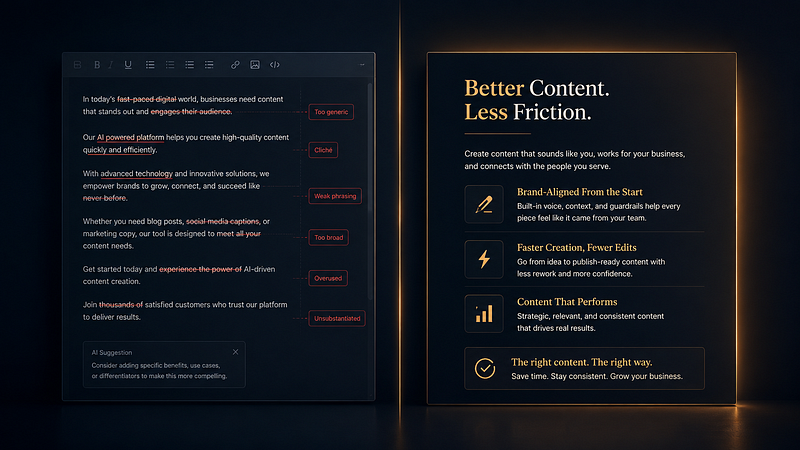
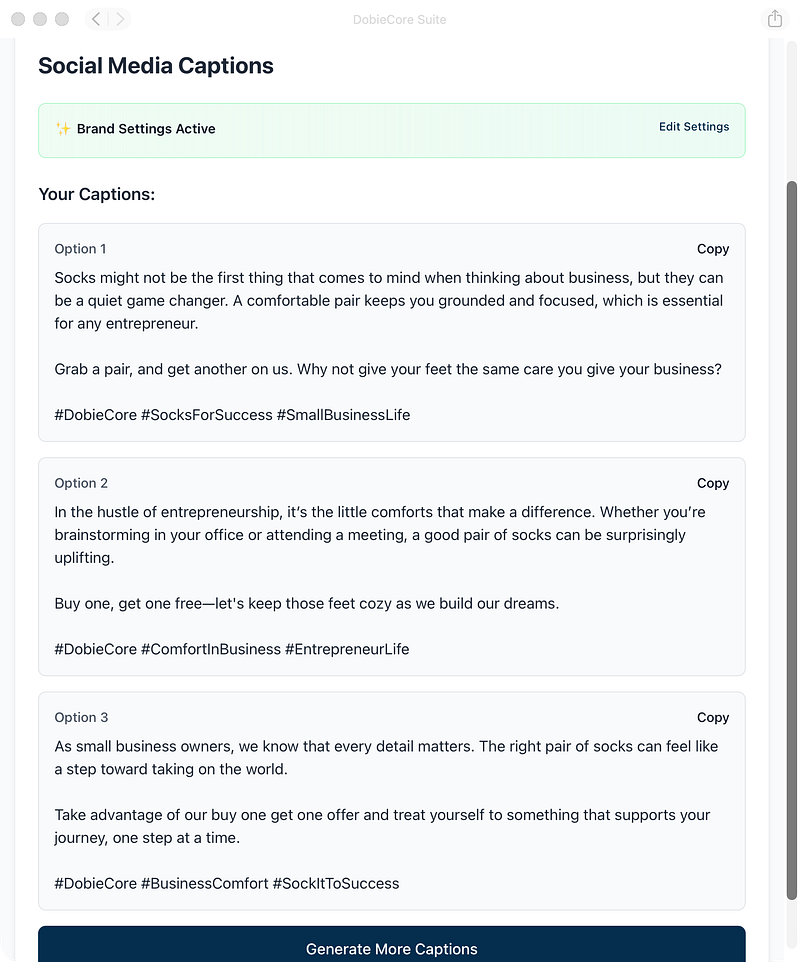
I recorded this comparison vertically because it was originally made for social, but the format fits the point: in under 90 seconds, the difference is not just speed. It is how much cleanup is left after the output appears.
The point of this comparison is not that DobieCore is magic. It is not.
The point is that context changes the starting line.
Generic AI can generate something quickly, but the result still needs voice repair, factual correction, and brand judgment. DobieCore starts with the brand already in the room, so the first draft is closer to something a real business can actually use.
The test is not about which AI writes faster. The test is about which result requires less cleanup afterward.
What Happens After the First Draft Matters More Than the First Draft

Most AI demonstrations stop when the text appears.
Real businesses start working when the text appears.
There is a hidden cost in almost every AI content workflow that nobody talks about in the demos. It shows up in the editing phase. Voice repair — rewriting sentences that sound like a committee of robots made a group decision. Fact checking — catching the places where the AI confidently filled in details it did not actually have. Formatting fixes, rewriting for audience, pulling the output back toward something that sounds like the person who owns the business.
That time adds up. And it adds up every single time, for every single piece of content, if the system has no memory of who you are.
Speed at generation is easy to sell. The cost of the editing phase is much harder to see until you are already inside it.
Context Changes the Starting Line
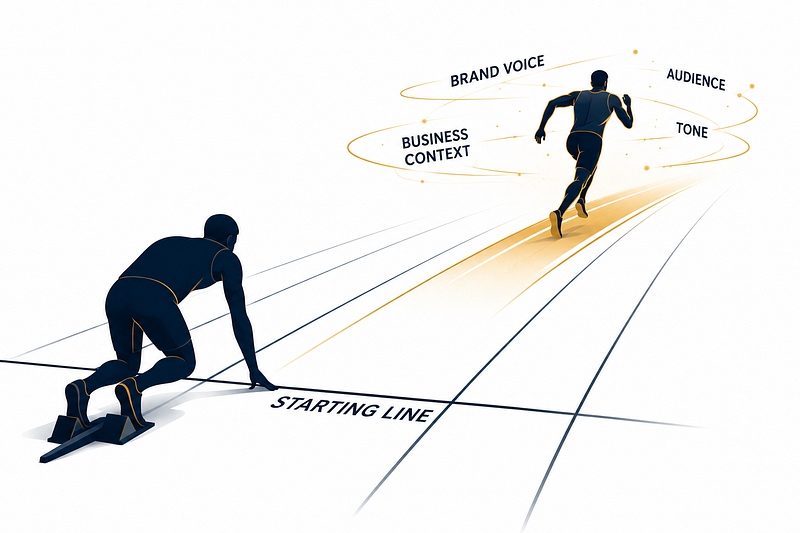
Generic AI starts with a prompt, a blank slate, and no brand knowledge.
Every session is the first session. The AI does not know your tone, your audience, what you would never say, or the six things you have already tried and abandoned. You are responsible for rebuilding that context from scratch each time you open the tool.
DobieCore starts differently.
Before a single word is generated, the system already carries your brand voice, your business context, your services, your audience, and your existing workflows. You are not starting from a blank page. You are starting from a foundation.
The result is not perfect. It is simply closer.
Closer means less repair. Less repair means less time. Less time means the content actually gets published instead of sitting in a draft folder while you decide whether it is worth fixing.
The Difference Between Information and Judgment
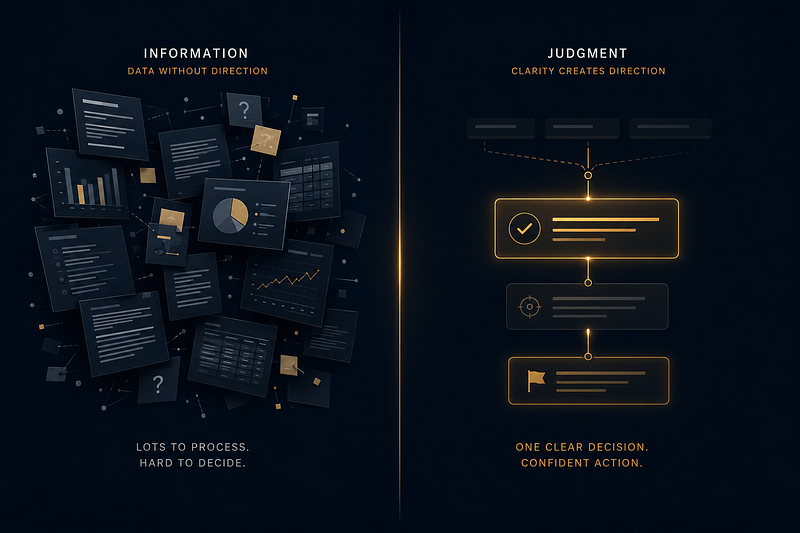
AI can generate information.
Businesses need judgment.
Those are not the same thing, and the gap between them is where most AI content workflows quietly fall apart.
Judgment is what decides what to emphasize and what to cut. It is what recognizes that a phrase is technically accurate but off-brand. It is what knows your customers well enough to anticipate the question a sentence might accidentally raise. It is what sounds like the owner.
AI does not have that. Not on its own.
What good AI infrastructure can do is reduce the number of unnecessary decisions that have to be made before judgment can enter the room. If the voice is already calibrated, if the brand rules are already applied, if the structure is already reasonable — then the human’s attention can go to the places where it actually matters.
DobieCore is not replacing judgment. It is reducing the decisions that should never have required judgment in the first place.
Why I Built DobieCore
I spent years building websites and digital systems for small businesses.
In that time, I watched the same bottleneck appear in almost every content workflow I touched. A business owner would try an AI tool, get something generic, spend an hour editing it into something usable, and then quietly conclude that AI was more work than it was worth. Or they would keep using it, keep editing, and never quite close the gap between what the tool gave them and what their brand actually needed.
The problem was not the model. The problem was that nobody had given the model anything to work with.
Most people who run small businesses do not want to become prompt engineers. They do not want to study AI behavior, test a hundred variations of the same input, or build elaborate instruction sets from scratch. They want content that is credible, on-brand, and done. They want consistency. They want fewer decisions.
That is the problem DobieCore is built to solve.
AI Autopilot Is Not the Goal
There is a common assumption that the best AI system is the one that does the most on its own.
That assumption is worth questioning.
More automation is not always better. A system that removes the human from the loop does not make better content — it makes faster content that may or may not represent the business that is supposed to be publishing it. The goal is not to take human judgment out of the process. The goal is to make human judgment cheaper to apply.
Good AI infrastructure reduces friction. It does not remove responsibility.
The businesses that use AI well are not the ones handing everything to the model and publishing whatever comes back. They are the ones who built systems that bring the model closer to the brand, so that when a human reviews the output, most of the structural work is already done.
People should remain in the loop. Systems should make staying in the loop easier, not give you reasons to opt out of it.
The Real Metric
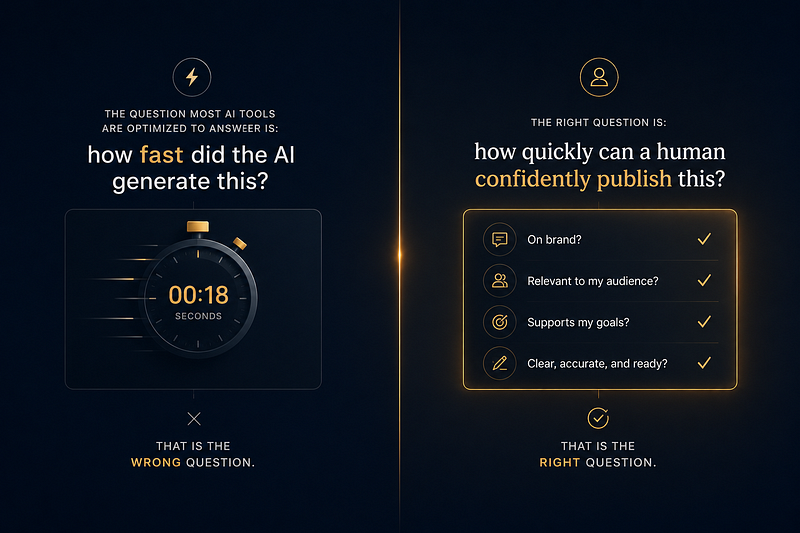
The question most AI tools are optimized to answer is: how fast did the AI generate this?
That is the wrong question.
The right question is: how quickly can a human confidently publish this?
Time-to-generation and time-to-publish are not the same number. The gap between them is where most of the real cost lives. A caption that generates in eight seconds and requires forty-five minutes of editing is not a fast tool. It is a fast draft with a slow tax attached.
That is the metric DobieCore is built around. Not raw generation speed, but the distance between output and something a business owner can actually stand behind.
The Future Is Better Starting Points
The future of AI content is not faster generation.
The future is better starting points.
The businesses that win will not necessarily be the ones with the most AI. They will be the ones with systems that reduce friction while preserving judgment. Systems that remember the brand so the owner does not have to rebuild it from scratch every time. Systems that handle the structural decisions so human attention can go to the places where it actually counts.
That is the problem DobieCore is trying to solve.
Try It Yourself
We are just getting DobieCore out into the world, and I wanted the first people through the door to be the ones who actually need it most. To read more about DobieCore, check out this article, I’m a Developer Who Hated AI Content Tools, So I Built a Better One.
Try DobieCore free — no credit card required.
Go ahead and type “buy one get one socks.” Compare your current workflow and DobieCore…
See what happens.
Melanie Brown is the founder of Bluedobie Developing, a rural Kentucky-based SaaS and web development company, and the creator of DobieCore — an AI content platform engineered to give small business owners professional results without the prompt engineering learning curve. She writes the Bluedobie Dialogues series about systems thinking, sustainable business architecture, and what durability actually looks like in practice.