
Workplace Anxiety Is a Systems Signal
If a workflow only holds when you are calm, rested, and fully resourced, it is not durable. It is conditional.
If a workflow only holds when you are calm, rested, and fully resourced, it is not durable. It is conditional.
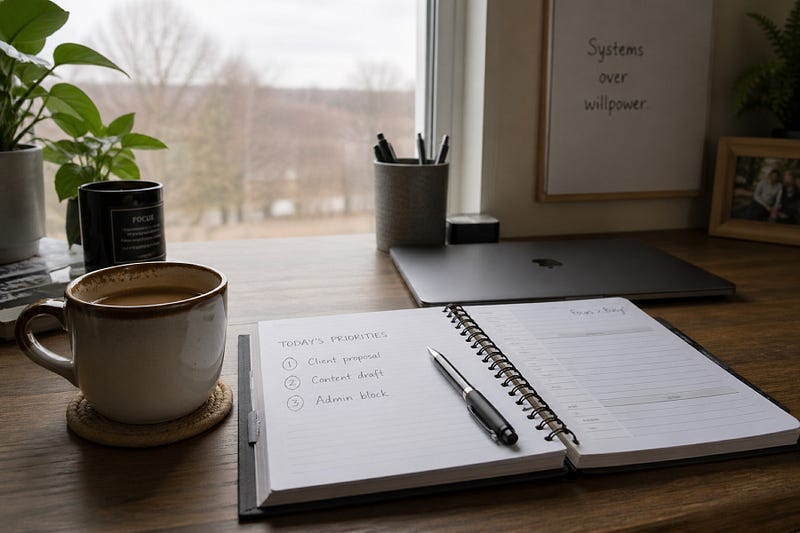
Workplace anxiety is usually treated as a personal management problem. The person experiencing it is expected to breathe, regulate, reframe, and keep producing at the same pace.
That framing misses the structural question.
Sometimes anxiety is not evidence that someone cannot handle the work. Sometimes it is evidence that the work has been arranged with no tolerance for variability.
Most work systems are built around a quiet assumption: the same person arrives every morning with the same amount of focus, patience, memory, confidence, and decision-making capacity. The calendar is planned that way. The inbox is handled that way. The deadlines are assigned that way.
It is an elegant fiction until a real nervous system enters the room.
Anxiety does not always remove capacity completely. More often, it changes the cost of ordinary things. A message takes longer to answer. A meeting takes more recovery. A small decision starts carrying the weight of a much larger one. The work may still be possible, but the margin around it gets thinner.
That margin is where many systems fail.
The Stable Capacity Assumption
Most productivity advice assumes a stable baseline. It assumes the worker can look at a list, identify what matters, choose the next step, and begin.
On a clear day, that may be true.
On an anxious day, the starting point is different. The body may already be carrying noise before the first task opens. There may be nothing visibly wrong. No crisis. No dramatic collapse. Just a narrower field of attention and a nervous system treating ordinary inputs as if they require constant review.
An email that should take three minutes takes twelve because tone has to be checked, then softened, then checked again. A meeting that should be routine leaves a residue that follows into the next task. A calendar reminder interrupts more than a calendar; it breaks the fragile thread of focus that was holding the morning together.
The cost is not emotional in some vague, decorative sense. It is operational.
Anxiety consumes decision bandwidth. It lengthens transitions. It distorts urgency. It turns the beginning of a task into a threshold that has to be crossed with more effort than the task itself may deserve.
This is why “just prioritize” is often unhelpful advice. Prioritization requires the very cognitive resources anxiety is already spending.
A workflow that depends on calm assessment at every turn is fragile. It may look organized from the outside, but it is asking too much from the moment most likely to have the least available capacity.
The 50% Capacity Test
A durable system should not require a person to be at full capacity in order to function.
That does not mean a reduced-capacity day should produce the same output as a fully resourced day. That is just hustle culture wearing softer shoes. The point is not to extract the same result from a depleted body.
The point is to prevent collapse.
The 50% Capacity Test is simple: what still works when you only have half your usual cognitive room?
If the answer is “nothing,” the system is not supporting you. It is cooperating only when conditions are favorable.
A kitchen organized for real life does not require every dish to be clean before dinner can happen. There are repeatable places for the things used most often. The pan that always gets used is not stored behind the one brought out twice a year. The coffee is not placed where it requires a scavenger hunt before sunrise.
That is not perfection. It is design under constraint.
Work needs the same kind of thinking. The system should reduce unnecessary search, unnecessary choice, and unnecessary recovery. It should make the next right action easier to find when the mind is not at its best.
Anxiety reveals where that architecture is missing.
Build Defaults Before You Need Them

The anxious workday is not the ideal time to design the workday.
Defaults matter because they remove negotiation. A default first task, a default communication window, a default way of sorting incoming requests — these are not rigid rules. They are handrails.
A simple morning structure might be enough: one anchor task, one maintenance block, one communication window. The details will vary by job, but the principle holds. Decide the shape of the day before the day starts making demands.
This is less about discipline than load reduction.
When every task asks, “Am I next?” the mind has to keep answering. That repeated answering becomes expensive. Anxiety makes it more expensive.
A default order protects the day from becoming a series of fresh decisions. It gives the brain fewer open loops to hold.
The same applies to communication. An inbox has no moral hierarchy. It presents a client concern, a newsletter, a calendar update, and a casual “quick question” in the same visual field. Your nervous system may register all of them as arrivals requiring attention.
That does not mean every message deserves immediate access.
Batching communication is not avoidance. It is boundary architecture. It gives attention fewer doors to guard. A person cannot do deep work while also serving as a live receptionist for every notification that enters the room.
Some roles require faster response times than others. The principle still applies. Even a fifteen-minute container is different from continuous exposure. A closed door is not the same thing as an abandoned house.
Transitions Are Part of the Work
Anxiety makes transitions more expensive, and most schedules pretend transitions do not exist.
The calendar moves from one block to the next as if attention can cleanly detach from a meeting, arrive inside a spreadsheet, write a difficult reply, and then enter a planning call without residue. That may happen on a good day. It is not a reliable design assumption.
Transitions need space because attention has texture. It carries what it just touched.
A useful transition does not have to be elaborate. It can be a short walk, a glass of water, closing the tabs from the last task, or writing one sentence about where to resume later. The value is not in the ritual itself. The value is in marking the crossing.
Without that crossing, the day becomes one continuous surface. Everything touches everything else.
This is where anxious days often start to unravel. Not at the largest task, but in the seams between tasks. The recovery never happens, so the next thing begins with leftover strain from the previous one.
A system that includes transitions is not indulgent. It is more accurate.
Load Indicators Are Data
Most people have early signs that capacity is dropping before the drop becomes obvious.
Rereading the same paragraph. Feeling unusually sensitive to tone. Avoiding a task that is normally manageable. Getting irritated by small requests. Opening three tabs and using none of them. Deciding the desktop must be reorganized before any real work can begin, which is occasionally true but usually suspicious.
These signs are not character evidence.
They are load indicators.
A load indicator is useful because it appears before the failure point. It gives the system a chance to adjust. That adjustment may be small: reduce inputs, move a difficult conversation to a steadier window, switch to a lower-friction task, write the first sentence instead of trying to complete the whole piece.
The purpose is not to monitor yourself into another kind of anxiety. It is to stop treating signals as verdicts.
A body under strain will usually speak before it refuses. The earlier the system listens, the less dramatic the correction has to be.
Some Environments Generate the Anxiety They Then Ask People to Manage
There is a limit to what personal systems can solve.
Some workplaces are structurally dysregulating. Expectations change without being named. Urgency is used as a management style. Visibility is mistaken for value. Every channel is treated as immediate. A person who is visibly stressed is told to be more resilient, while the conditions producing the stress remain untouched.
In that kind of environment, anxiety is not merely being triggered. It is being manufactured.
A better personal workflow can make a difficult environment more survivable. It can protect some bandwidth. It can reduce unnecessary decisions. It can create pockets of steadiness where control exists.
But coping skills cannot fully compensate for a broken container.
That distinction matters because it keeps responsibility in the right place. There is a difference between a person needing better support and a workplace needing better architecture.
Both can be true. They are not the same problem.
The Durable Version

Managing workplace anxiety is not about becoming unaffected by work. That is not a serious goal for a human life.
The more useful aim is to build systems that can hold when capacity changes. Systems with defaults. Systems with fewer unnecessary decisions. Systems that respect transitions. Systems that treat early strain as information instead of failure.
A workday designed only for full capacity will always be vulnerable. It may look efficient, but it has no tolerance. One hard morning, one noisy inbox, one poorly timed meeting, and the whole structure starts asking the person inside it to compensate.
That compensation has a cost.
Workplace anxiety does not always mean you are failing at work. Sometimes it means the work has been built around a version of you who has no body, no nervous system, no interruptions, no grief, no hormones, no sleep debt, no sick kid, no aging dog, no bad weather, and no ordinary human fluctuation.
That version of you is easy to schedule.
She is also fictional.
Notice where your workflow only works when you are at full capacity.
That is not where you are weak. It is where the design is unfinished.
Melanie Brown is the founder of Bluedobie Developing, a rural Kentucky-based SaaS and web development company. She writes the Bluedobie Dialogues series about systems thinking, sustainable business architecture, and what durability actually looks like in practice.