
The Hidden Risk of Failure in Most Shopify Stores: They Were Never Designed as Systems
Most Shopify store owners spend time improving their storefront. Far fewer spend time designing the systems that keep that storefront…

Most Shopify store owners spend time improving their storefront. Far fewer spend time designing the systems that keep that storefront running when something goes wrong.
If you are unable to read this article in its entirety, please click here.
A Shopify store can look polished, load quickly, and even generate consistent sales. From the outside, everything appears to be working.
Then someone gets sick.
A supplier misses a shipment.
An app breaks after an update.
An email automation silently stops firing.
A password is stored in one employee’s head.
And suddenly the business discovers an uncomfortable truth:
The store was functioning. The system was not.
A Store Is Not a System
When most people think about e-commerce, they think about the website.
The homepage.
The product pages.
The checkout experience.
The design.
Those things matter. But they are only the visible layer.
Behind every successful Shopify store is a collection of interconnected systems:
- Inventory management
- Supplier relationships
- Customer service processes
- Marketing workflows
- Email automation
- Documentation
- Analytics
- Payment processing
- Shipping and fulfillment
The storefront is what customers see. The system is what keeps everything moving.
The Single Point of Failure Problem
One of the most common weaknesses in small businesses is the existence of single points of failure.
A single employee who knows how to process returns.
A single spreadsheet that tracks inventory.
A single app that connects multiple workflows.
A single founder who carries every piece of institutional knowledge.
Everything works until that one thing becomes unavailable.
Systems thinking asks a different question:
“What happens if this breaks?”
That question is often more valuable than asking how to grow faster.
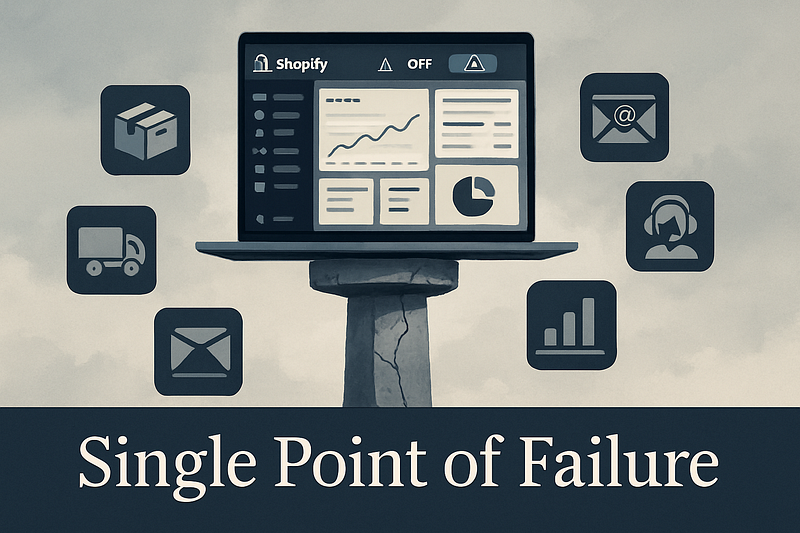
The cracked pillar in that illustration is intentionally obvious.
Real business failure points rarely are.
A Real-World Example: Bluedobie Shop
Recently, while reviewing activity on Bluedobie Shop, I noticed something that had very little to do with products and everything to do with systems.
The store was receiving an increasing number of spam messages and fake sales inquiries.
At first glance, spam looks like a marketing annoyance. From a systems perspective, it is a warning signal.
Every spam message consumes attention. Every fake inquiry creates noise. Every unnecessary notification increases the chance that a legitimate customer question gets overlooked or delayed.
The problem is not the spam itself. The problem is what happens when the business has no process for handling it.
A weak system treats every incoming message the same way:
- Every inquiry requires manual review.
- One person handles all communication.
- No filtering exists.
- No qualification process exists.
Over time, the cognitive load grows.
A stronger system introduces safeguards:
- Spam filtering
- Contact form validation
- Lead qualification questions
- Email rules and routing
- Documented response processes
The goal is not perfection. The goal is resilience.
Most business owners ask:
“How do I get more leads?”
Systems thinkers eventually ask a different question:
“Can my process reliably handle the leads I already have?”
That question often reveals weaknesses that marketing metrics never will.
Designing for Resilience
Resilient systems assume that interruptions will happen.
Instead of designing around perfect conditions, they prepare for imperfect ones.
A resilient Shopify ecosystem might include:
- Documented procedures for recurring tasks
- Backup suppliers
- Shared password management
- Automated alerts for failed workflows
- Inventory thresholds and reorder triggers
- Multiple team members capable of handling critical functions
None of these changes are particularly exciting.
Most of them will never appear in a marketing screenshot.
Yet they are often the difference between a temporary inconvenience and a business disruption.
Accessibility Is a Systems Problem Too
Accessibility is often treated as a design issue.
In reality, it is also a systems issue.
A store that depends on inaccessible navigation, poorly structured content, or inconsistent product information creates friction throughout the entire customer journey.
When accessibility is built into the system rather than treated as a last-minute fix, the benefits ripple outward:
- Better user experiences
- Stronger SEO
- Reduced customer support requests
- Improved conversion opportunities
Good systems reduce friction. Accessibility does exactly that.
The Strongest Shopify Stores Think Beyond the Website
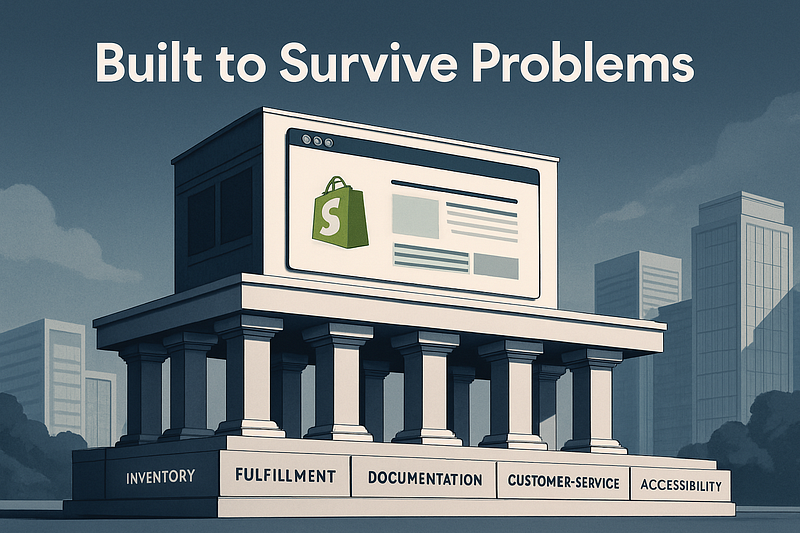
The businesses that survive unexpected challenges rarely do so because they have the prettiest storefront.
They survive because they have designed processes that continue functioning when conditions are less than ideal.
A Shopify store sells products.
A Shopify system protects the business that sells them.
The difference becomes visible the moment something goes wrong.
And eventually, something always does.
Final Thought
If you only improve one thing this month, do not start by asking how to increase traffic.
Start by asking:
What would happen if one critical part of my store stopped working tomorrow?
The answer will tell you far more about the health of your business than your conversion rate ever could.