
The Day Everything Broke Open
Chapter 10 of The Woods Behind Me
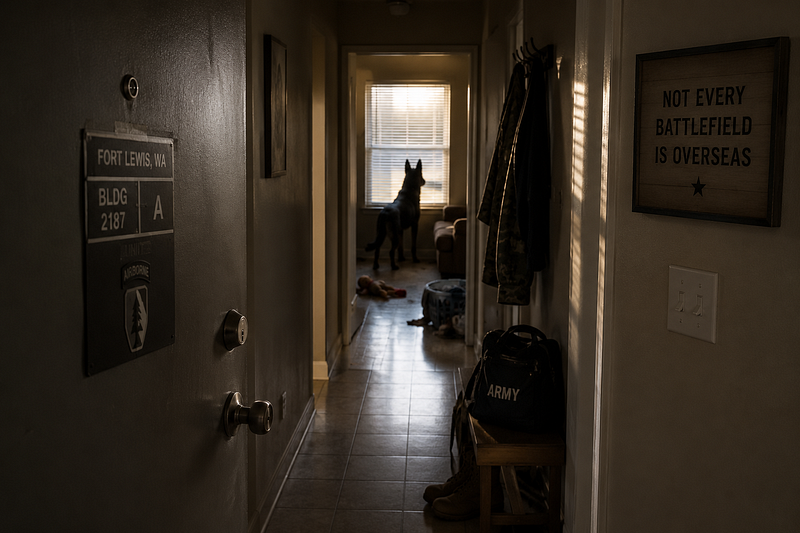
There are days that split a life into two parts — the before and the after — and you never see them coming.
This one arrived on an ordinary morning at Fort Lewis when three MPs kicked in my door.
I shot awake to chaos — barking, shouting, boots pounding, adrenaline spiking through a fog so thick I could barely lift my head. Pez launched toward the stairs, eighty pounds of Rottweiler fury and loyalty, barking with everything in him.
I stumbled toward the noise — drugged, disoriented, moving through a nightmare that was somehow happening in daylight.
And that’s when I saw it:
An MP at the bottom of the stairs with his gun drawn, aimed up toward where I was standing.
Pez was frantic. The MPs were shouting. I was barely conscious.
That image burned itself into me forever.
I’d taken two capsules of Seroquel the night before — 600mg total — because a doctor told me it would help me sleep. They didn’t start small. They didn’t titrate. They didn’t warn me. They just handed me a bottle and sent me home.
The pills didn’t put me to sleep. They erased me.
I didn’t hear the alarm. Didn’t hear the phone. Didn’t hear my kids moving around the house. Didn’t even hear the receiver hit the floor when I knocked it off the hook in my sleep.
I simply disappeared.
The Night Before
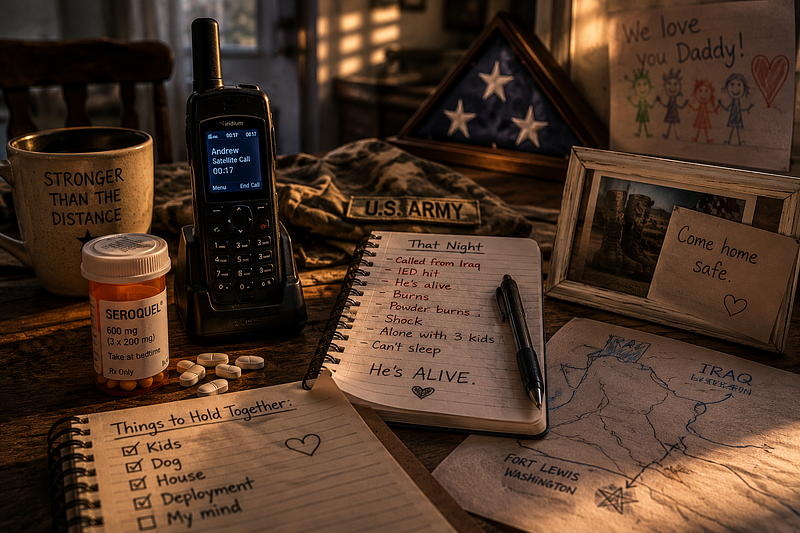
The day before, my husband had survived an IED in Iraq.
Except he didn’t tell me that. Not at first.
The call came through on a satellite phone — static, distance, Andrew’s voice shaky but alive.
“I’m okay,” he said first, because that’s what soldiers do. They lead with survival before they explain the cost.
“What happened?”
“I was in an accident.”
That word sat wrong in my chest — too soft, too small for the tension in his voice.
“What kind of accident? Did you hit a camel?”
It was the only thing that made sense. Convoys. Desert roads. Wildlife.
He laughed. Or groaned. Hard to tell through a satellite phone held by a man still covered in dust and burns.
“No. Hit an IED. Thirty yards past the checkpoint. Mirror exploded. Got some powder burns.”
My brain stalled.
IED. Not a camel. Not an accident. An explosion.
My mind couldn’t process it. Couldn’t shape the words into images. Couldn’t hold the weight of what almost happened.
So I clung to the only part that felt manageable:
He was alive. He was talking. He was still here.
I took the Seroquel that night because I couldn’t sleep. Because my husband had nearly died and I was alone in a house with three kids and a dog and a body that wouldn’t stop running its emergency systems.
I didn’t know the pills would erase me.
I didn’t know my kids would dress themselves and walk to school alone.
I didn’t know three MPs would be standing in my house by morning.
What They Saw. What They Didn’t.
The MPs made their assessments quickly.
They saw: laundry piled two feet deep in the laundry room. A panicked dog. One room that looked like a warzone — because it was. Pez had made it his emergency bathroom after Ivy fed him raisins the night before. I didn’t know raisins were toxic to dogs. I didn’t know a lot of things then. A mother who couldn’t stand upright. Three kids who’d dressed themselves and walked to school alone.
They didn’t see: the 600mg of Seroquel that had knocked me unconscious. The untreated bipolar disorder. The warzone I’d been holding together through a phone line. The depression so heavy I couldn’t motivate to complete basic tasks. The laundry hidden in the laundry room because I’d been barely surviving, not neglecting. The absence of support. The sheer weight of surviving.
They took my kids. Placed them with Mae — one small mercy in an avalanche of judgment.
And then came the demands: give up the dog, clean the house, prove yourself, prove your worth, prove your motherhood.
As if motherhood lives or dies by laundry piles.
As if a medication overdose is a character flaw.
As if surviving your husband’s near-death in a warzone while managing untreated bipolar disorder is something you should just handle better.
Typhoon Mandi and Tsunami Mae
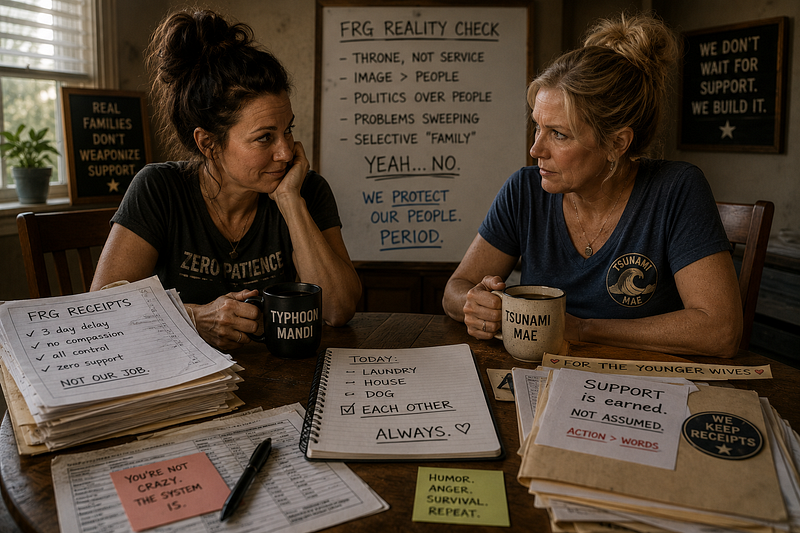
By the time the MPs came, I already knew exactly how much support was real and how much was theater.
I’d learned it from the FRG.
The Family Readiness Group was supposed to be exactly what the name promised. Ours was run by the platoon sergeant’s wife — a woman who treated “family readiness” like a throne and the rest of us like her unwilling subjects. She had authority without empathy and wielded both with the enthusiasm of someone who enjoyed the sound of her own power.
When Andrew was hit, it took her three days to call me.
Three days.
I could’ve been dead on the floor, and she still would’ve opened with that same clipped, icy tone that made compassion sound like a scheduling conflict. No “I’m so sorry this happened.” No human warmth at all. Just a flat, obligatory: “I had to call and check on you.”
When I hung up, Mae and I reacted the only way we knew how: by weaponizing humor to survive anger. We decided it would probably take a three-foot novelty auger to clear out whatever had lodged her personality so deep she couldn’t manage basic kindness. Crude? Yes. Completely inappropriate? Obviously. Exactly what kept us from combusting that day? Absolutely.
Mae saw the hypocrisy long before I did — the way the FRG loved to brand itself as “family” but evaporated the moment a real crisis demanded actual care. Where others folded themselves neatly into the system, Mae and I sharpened. We became the ones who kept receipts, who asked the questions no one wanted to answer, who made sure the younger wives weren’t left drowning.
That’s where Tsunami Mae and Typhoon Mandi were born. Not from chaos. Not from drama.
Necessity.
Two forces of nature shaped by a wind that should have been shelter but became a test.
Colorado, Days Before
A few days before that deployment, we were in Colorado with the other families — that photo of all of us trying to pretend we weren’t terrified.
Mae and I had brought our pet ball python and convinced half the group it was a baby anaconda. We ran around with that snake like it was the most dangerous thing any of us would face that year. We were wrong about that, as it turned out.
At dinner, the men started joking about deployment logistics. Spooning at night. Who’d be the big spoon. Laughter all around the table.
Except me.
I froze.
My brain — still wired from old relationships, old betrayals, old abandonments — heard that joke and translated it into: he’s going to leave you. He’s going to walk away while he’s gone.
It upset me. Scared me. Made me quiet in a way that didn’t match the energy of the room.
Looking back, I can see how unfair that was to Andrew. How much that moment revealed about my own unhealed wounds, not anything he’d done. It was a trauma response — a scared girl inside a grown woman’s body, waiting for the other shoe to drop.
He wasn’t going anywhere. He never did.
But I didn’t know that yet.
What Actually Happened in Iraq
Andrew had been driving the LT that day, not the HET he normally handled. Just thirty yards past an Iraqi police checkpoint — not even a full minute beyond it — the world went white.
Blast. Heat. Metal peeling apart.
The mirror exploded in his face, peppering him with powder burns in an instant. His truck wasn’t armored. It had no business surviving an IED. But he’d shoved an extra flak vest into the door earlier — just a habit, the quiet instinct soldiers grow when luck is the only armor they get.
That vest probably saved his life.
Dazed and bleeding, he did what soldiers do: he drove the convoy the rest of the way to Camp Cook. No panic. No theatrics. Just grit and a steering wheel held by a man who understood that stopping meant someone else died.
Hours later, the Department of the Army called to notify me officially. For a moment I thought: how could he have been in another IED blast? Only then did I understand they were calling about the same attack — the one that had already hollowed me out.
War breaks in waves, not single moments. And some days those waves hit before you’ve even finished breathing from the last one.
Jack
In that moment when I needed support the most, my options were almost nonexistent. My mother-in-law wasn’t emotionally available. There was no safe way to reach out to anyone else in the family.
But Jack was different.
He had always worked long, grueling hours. He wasn’t expressive or sentimental, but he was steady. Loyal. The kind of man who showed love through action, not words. Our birthdays were two days apart — our little Virgo joke — and maybe that was why we understood each other without needing much spoken.
When the world collapsed at Fort Lewis, he didn’t hesitate. He showed up.
While Mae kept the kids, Jack stayed by my side for the next 24 to 48 hours. Not judging. Not questioning. Just helping.
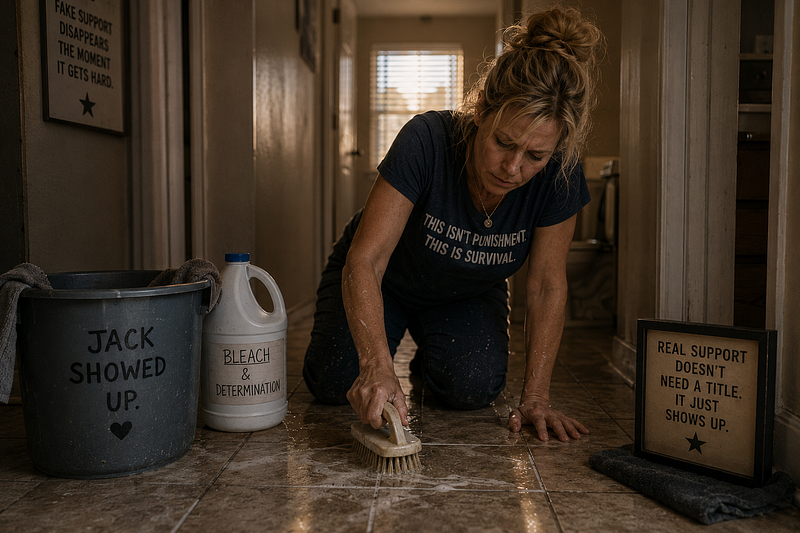
He helped me scrub those tile floors — long military hallways, cold squares of government-issue ceramic, the whole house smelling like bleach sharp enough to sting my eyes.
I scrubbed until my hands cracked open. Not mopping — that felt too easy. I was on my knees with rags, a toothbrush, a scrub pad and a bucket, scrubbing humiliation out of grout lines, terrified Family Services might return and see any imperfection.
Mixed episode? Absolutely.
But in the moment, it was survival.
Jack stayed through all of it. Quiet. Steady. Offering the only real support I had when everything else fell apart.
He was the man who once kept our pet snakes in his apartment so we wouldn’t lose them. The man whose presence lifted me when others wanted me pushed down. The man I later honored with my first memorial tattoo.
He was the hand that reached for me when no one else did.
The Purple Heart They Argued About
My husband survived an explosion in an unarmored vehicle. Burned. Peppered with debris. Drove the convoy to safety through sheer refusal to stop.
And some genius in his chain of command had the audacity to argue that he didn’t qualify for a Purple Heart because he had failed a PT test.
As if push-ups determine whether shrapnel counts.
I learned something in those months that I already half-knew from the doctor’s office at seventeen, from the restaurant, from every system that had held me at arm’s length while calling itself support:
Institutions are not the same as care. Authority is not the same as accountability. And the people who show up with paperwork are rarely the people who show up with a scrub brush at 2 a.m.
Jack showed up with a scrub brush.
Andrew showed up with survival.
Mae showed up and kept my kids safe while I put myself back together one grout line at a time.
The system that was supposed to hold us together was the last thing that did.
If this chapter stayed with you, save it for a quieter moment or share it with someone who understands that survival is not always graceful while it is happening.
This piece is part of The Woods Behind Me, an ongoing memoir about trauma, systems, motherhood, memory, and the people who showed up when the official supports failed.
Follow Bluedobie Dialogues for the next chapter.
Melanie Brown writes memoir, essays, and systems-minded reflections about survival, motherhood, trauma, rebuilding, and the strange architecture of a life that had to be rebuilt more than once. Her memoir series, The Woods Behind Me, traces the moments that shaped her understanding of care, failure, resilience, and what it means to keep going without pretending it was easy.