The Architecture of “No”: Building a Governed AI System
How to Avoid the “Shiny Button Trap”

I have a recurring problem. I find a “shiny button” — a feature idea, a UI tweak, a clever way to automate a minor annoyance — and my brain immediately wants to build it right now.
In a vacuum, that’s just being productive. In a complex project, it’s a structural hazard. Without a system to catch those impulses, projects don’t just grow; they bloat until they become unmanageable. I call this the “PT Loser” effect: shiny buttons make you want to jump into building before you have stopped to ask whether you even want the product waiting on the other side. Keep following the dopamine instead of the purpose, and you can eventually discover that you built a product you hate.
To build Bifrost, I had to move away from “working with AI” and toward “governing AI.” I needed a system that didn’t just help me do things faster, but prevented me from doing the wrong things in the first place.
The Triad of Authority
The system works because of a very specific hierarchy of roles. It isn’t a democracy; it’s a governed pipeline.
The Final Authority (Me): I own the vision. I decide what the project is. I have the power to move any gate, but I also have the responsibility to keep the gates closed when they should be.
The Architect (Christopher): Christopher defines and guards the architectural gates. He ensures that when a gate is open, the “how” is sound. He builds the walls so that the work stays contained.
The Implementation (Claude): Claude is the construction crew. It does the heavy lifting — writing the code, digging through “ancient artifacts” in the codebase, and executing the plan within the strict bounds Christopher has set.
The Gatekeeper Framework (BFS™, or the Big Fking Stick)
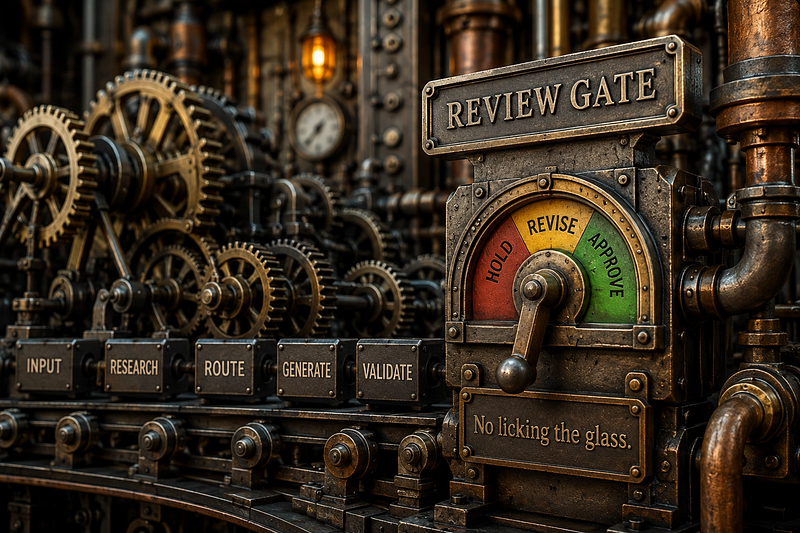
This hierarchy manifests as a series of “Gates.” Before a single line of code is written, the requirements must pass through a gate.
This is where the “Hodor” principle comes in. Hodor is the metaphor for holding the scope at the gate. It’s the constant, steady work of preventing the scope from expanding. It’s not about high-pressure moments; it’s about the daily discipline of saying “not yet” to the shiny buttons.
We also have a literal rule for the workflow: No licking the glass.
Just because a UI element looks finished or a button looks “clickable” doesn’t mean it’s ready. You don’t touch the shiny thing until it has passed the review gate. If you bypass the gate because the result looks good, you’ve broken the system. You’ve allowed a local success to create a global structural debt.
Governance in the Wild: The Value of Failure
If this were a marketing pitch, I’d tell you that this system makes development seamless. It doesn’t.
In real-world use, we see the friction clearly. We see the latency in generation. We see the “Load Failed” errors. We see the fact that cross-device persistence isn’t there yet. We see the missing optional Medium DB warnings.
To some, these are blemishes. To me, they are the point.
Governance doesn’t mean the system never fails. It means that when it fails, the failure is bounded, observable, and diagnosable.
Because the work is bounded by a gate, I have a clear map of which components are involved. When latency hits, I don’t have to guess which part of the entire house is slow; I know which room we’re currently building. When a “Load Failed” error appears, it doesn’t mean the AI has silently redesigned the house or corrupted the entire database. It means something in that request path failed, visibly. It’s a visible stop sign, not a structural collapse. It gives us a specific point to start the diagnosis.
By observing these imperfections — the routing, the optional-context degradation, the iterative corrections — we gain a clearer picture of the system’s limits. We aren’t looking for a magic wand that solves everything; we are building a cage for the chaos of LLMs.

The Durable Takeaway
The goal of this architecture is to reduce cognitive load. By making the big decisions at the gates, I don’t have to make a thousand tiny decisions during the implementation phase.
It allows for recoverability. If we stop at a clean gate, we can pick it up tomorrow. If we stop in the middle of a “shiny” rabbit hole, we have to spend three hours just remembering where we were and what we broke.
The best system is the one that works on your worst days — the days when you have a migraine, a full plate, and a very high urge to click on every shiny button you see. It’s the system that says “No” so that you can eventually say “Yes” to the things that actually matter.
If your workflow only works on your best days, it may not be a workflow problem. It may be a systems design problem.
Follow Bluedobie Dialogues for more practical essays on building work, tools, and routines that can survive real life.