
Foraging Principles in App Development: Building for 50% Capacity
In the quiet of a Western Kentucky forest, foraging is not a casual stroll until something useful appears. It is a study in pattern…

In the quiet of a Western Kentucky forest, foraging is not a casual stroll until something useful appears. It is a study in pattern recognition.
If you are unable to read this article in its entirety, click here.
A good forager isn’t just looking for morels or ramps. They are reading the conditions that make those things possible: the proximity of specific trees, the slope of the ground, the moisture retention of the soil, and the timing of the season. The mushroom is the visible result. The real work is learning to read the environment.
App development operates on the same logic.
Too often, we build software as if the goal is to clear-cut the forest and call it progress. We aim for maximum output — more features, more dashboards, more noise — and then express surprise when the system becomes too heavy for real people to use.
If we want to build durable applications, especially for people living interrupted, unpredictable lives, we have to stop thinking like disruptors and start thinking like foragers.
Discovery is Not Just Market Research

The standard advice is to start with market research. That isn’t wrong, but it is incomplete.
Market research tells you what people say they want. It shows you competitors, keywords, and trends. It does not always show you the friction someone carries through an ordinary day.
A forager does not walk into the woods asking, “Where is the prize?” They look for signs. They notice what changed since last season. They learn where something might take root.
That is the kind of discovery better app development requires.
When I look at tools like Sentrya or DobieCore, the question isn’t “What feature should this app have?” The question is: “What burden is the user carrying that this app could take off their hands?”
For Sentrya, that burden might be the cognitive load of remembering what happened during a migraine when the user is already light-sensitive and exhausted.
For DobieCore, it might be the friction of remembering the same brand decisions, content rules, and client details over and over again.
The feature is not the point. The relieved burden is the point.
Build for 50% Capacity

In foraging, taking too much from one patch damages the very conditions that made it useful. Sustainability isn’t sentimental; it’s practical. If you strip the ground bare, there is nothing for the next season.
Software can do the same thing to people.
A tool can demand too much attention. A workflow can depend on too much memory. A dashboard can ask for more interpretation than a user has the energy to give. A process can work beautifully on a “best day” and collapse the moment life becomes ordinary.
This is why I keep coming back to the 50% Capacity Rule.
If a system only works when I am rested, focused, pain-free, and uninterrupted, then it doesn’t actually work. It works for a version of me that doesn’t show up consistently.
The real test is this:
Can the system still help on a 50% capacity day?
Can it still guide the next step when my concentration is low?
Can it reduce the amount I have to remember?
Can it keep functioning when life is not arranged neatly around productivity?
That question has shaped my approach to app design more than almost anything else. It is why I prioritize context persistence. It is why I prefer structured interviews over giant blank forms. It is why I build tools that surface the next useful action instead of handing the user another pile of information to analyze.
Sustainable software doesn’t just conserve developer resources. It conserves user capacity.
Adaptability Is Not Chaos
A sudden rainstorm changes a forager’s plan. That isn’t a failure; it’s an environmental shift. Good foragers don’t argue with the weather. They adjust.
Last month, a pressure drop brought a vestibular migraine I hadn’t budgeted for. I had blocked the morning to code. Instead, I fed voice notes to Claude about the structure I needed, then rested. By afternoon, the outline was waiting for me. The system didn’t break because the human operating it needed to adapt.
App development needs that same adaptability, but not the frantic kind where every new idea triggers a rebuild. Durable systems need enough structure to hold their shape and enough flexibility to respond when reality changes.
I don’t want systems that require me to start over every time I learn something new. I want systems that can absorb new information.
When user feedback reveals a hidden need, the diagnostic becomes:
What needs to change? What should stay stable? What should be captured so I do not have to relearn this later?
That is the difference between reacting and adapting.
The same applies to AI-assisted work. A good AI workflow isn’t one giant model trying to do everything. It is a system that knows what context matters, which tool is appropriate, and when a task requires a different kind of thinking.
This isn’t about making software “fancy.” It’s about making the workflow survivable.
Ethical Design Starts With What You Do Not Take
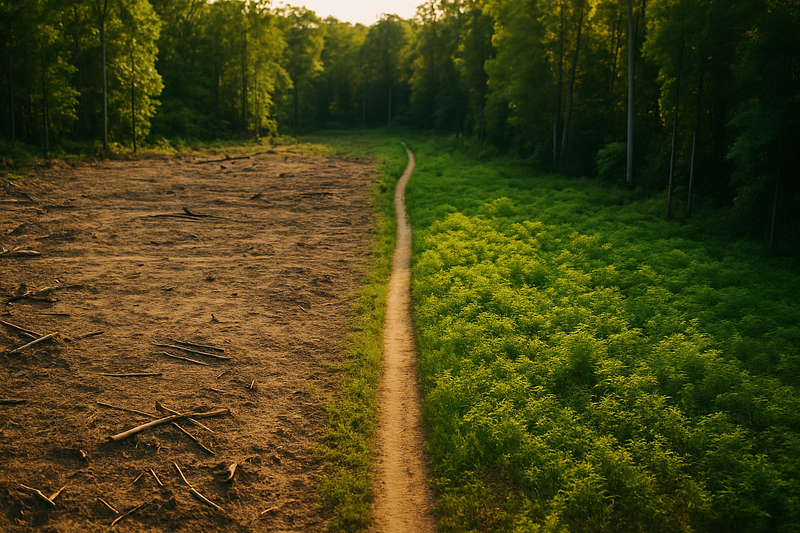
Foraging comes with a responsibility: do not take everything just because you can. Leave enough behind. Respect the land. Understand that today’s harvest is connected to next season’s growth.
App development carries a similar weight.
Do not collect data just because you can. Do not make users work harder just because the system can display more. Do not hide complexity behind cheerful language and call it “helpful.”
For health apps especially, trust is not decoration. It is architecture. Privacy, consent, and plain-language explanations are not afterthoughts; they are the baseline for whether a tool is safe to use.
A migraine patient should not have to become a data analyst to understand their own patterns. A small business owner should not have to rebuild their brand context every time they sit down to write. A caregiver should not have to carry every detail in their head because a system was designed for someone with unlimited attention.
Ethical software removes weight where it can.
Stability Is a Competitive Advantage

The field of app development moves quickly, but fast is not the same as durable. Growth without architecture is just weeds.
The apps I trust most are not always the flashiest. They are the ones that keep working when life gets messy. They do not demand peak performance from the person using them. They do not treat human attention as an endless resource. They understand that ordinary days are not edge cases.
That is the forager’s lesson:
Pay attention to the conditions. Take only what you need. Leave enough capacity for the next season. Build systems that can survive the weather.
When we apply these principles, we stop building tools that only impress people during a demo. We start building tools that still help when the user is tired, distracted, in pain, behind schedule, or simply human.
That is the kind of software I want to build.
Not software that asks people to become more machine-like. Software that remembers people are not machines.
If this piece helped you think differently about work, systems, or building a life that can hold real human limits, follow Bluedobie Dialogues for more essays on sustainable business architecture, practical workflows, and the human side of building things.
Melanie Brown is the founder of Bluedobie Developing, a rural Kentucky-based SaaS and web development company, and the creator of DobieCore — an AI content platform engineered to give small business owners professional results without the prompt engineering learning curve. She writes the Bluedobie Dialogues series about systems thinking, sustainable business architecture, and what durability actually looks like in practice.