
Automation Isn’t a Growth Strategy. It’s a Durability Strategy.
Why designing for 50% capacity creates a business that survives unpredictable seasons.
Why designing for 50% capacity creates a business that survives unpredictable seasons.
Most conversations about automation center on speed. How much faster can you deliver? How many more clients can you serve?
That was never my question.
When I built automation into my workflow through Make and began generating content through DobieCore, I wasn’t trying to move faster. I was trying to stop depending on conditions I couldn’t control. The goal wasn’t volume. It was cognitive protection.
Under the 50% Capacity Rule, automation stopped being a productivity tool. It became a structural requirement.
Automation Isn’t About Speed
The common framing positions automation as acceleration — do more, faster, with less effort. That framing assumes your baseline is stable. That you’re operating from consistent energy, consistent focus, consistent availability.
Most business owners aren’t.
There’s a meaningful difference between optimizing for peak performance and designing for variability. One assumes the good days will show up on schedule. The other accepts that they won’t — and builds accordingly.
The 50% Capacity Rule starts from a simple premise: your processes should function at half your normal energy, focus, and time. Automation is one of the primary mechanisms that makes that possible. Not because it removes effort, but because it protects where effort is spent.
The Hidden Cost of Repetition
Consider a web audit. On the surface, it looks manageable. Run the reports. Review the scores. Write the recommendations.
In practice, it’s dozens of small decisions layered together. You’re interpreting metrics, translating technical data into actionable language, structuring summaries, formatting documents, comparing scores, and rewriting variations of similar recommendations for different clients.
Each task is minor.
Stacked together, they create cognitive load.
At full capacity, it works. At 50%, it strains.
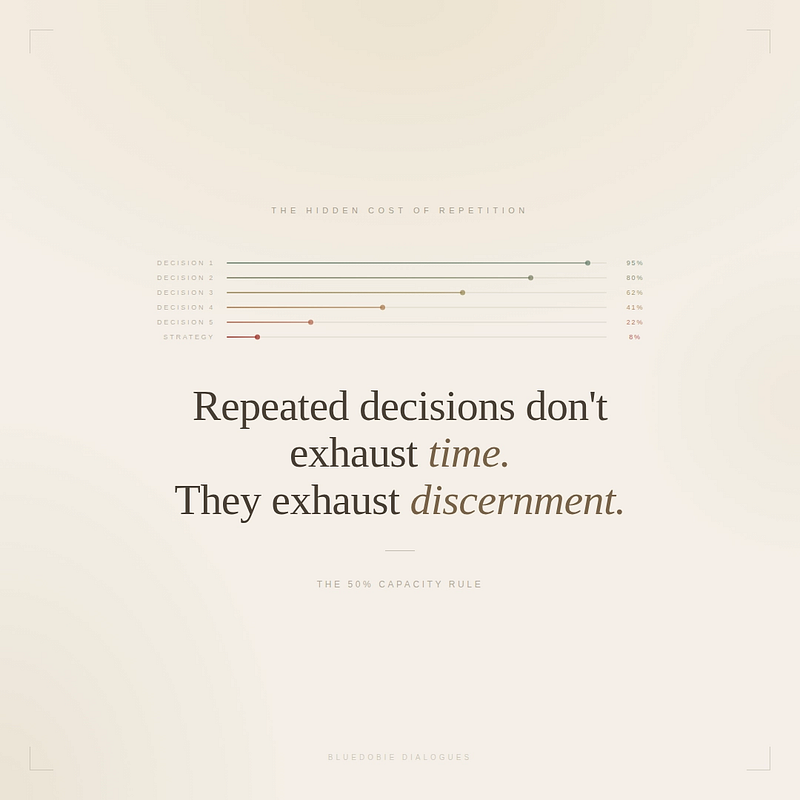
The work itself isn’t inherently difficult. What drains you is repetition that requires active judgment at every step. Repeated decisions don’t exhaust time — they exhaust discernment.
Cognitive bandwidth isn’t finite in theory. In practice, it absolutely is. Once depleted, the quality of everything downstream declines — not because you stopped caring, but because you ran out of the resource careful work depends on.
Removing Myself From Repetition
So I automated the audit.
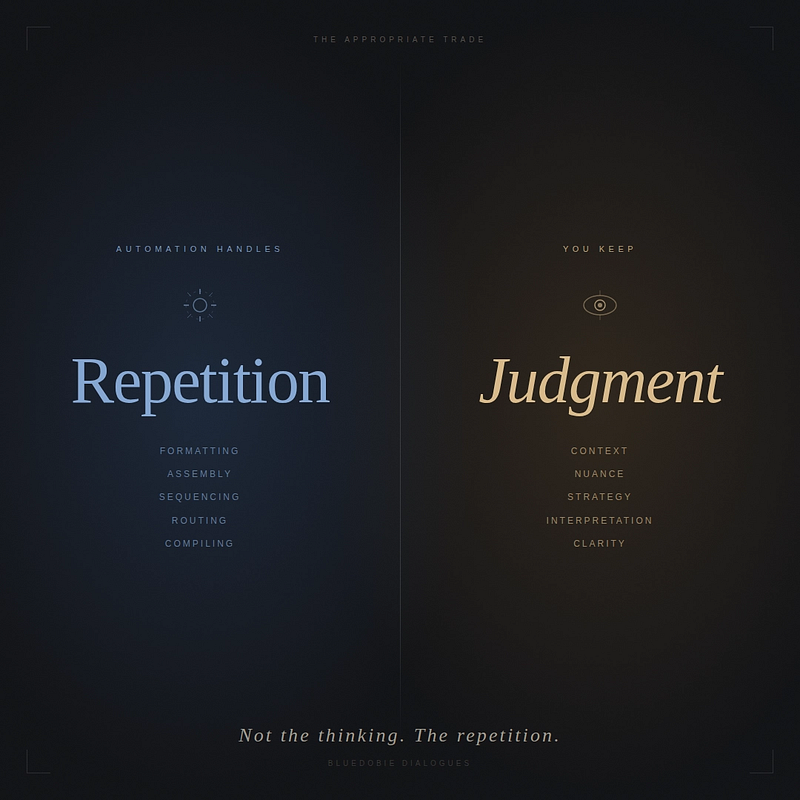
Not the thinking. The repetition.
Automated score logic handles the data layer. Standardized executive summaries establish consistent structure. Prebuilt recommendation frameworks eliminate the need to reconstruct similar conclusions from scratch. Document assembly manages formatting and sequencing. Conditional pathways route outputs based on score thresholds, removing low-stakes decisions from the manual process.
The result wasn’t simply faster delivery, though that followed. The result was consistency regardless of my capacity on a given day.
Automation reduced variability. The output became reliable even when my energy wasn’t.
Judgment Is the Only Thing That Should Depend on You
When automation handles repetition, capacity is preserved for judgment. That’s the appropriate trade.
Judgment is where value lives. Context. Nuance. Strategic interpretation. Those cannot and should not be automated.
Formatting a document doesn’t require judgment. Compiling scores doesn’t require judgment. Assembling a summary structure doesn’t require judgment.
Strategy requires clarity. Formatting does not.
When repetition and strategy compete for the same cognitive resources, strategy loses. Automation resolves that competition by removing repetition from the equation — not to make you faster, but to ensure the work that requires you still has enough of you left to do it well.
The Broader Business Lesson
Every business has a process that quietly drains cognitive energy. It rarely reveals itself at full capacity. It surfaces under constraint — during a difficult season, a health disruption, or a period of reduced bandwidth.
A founder who manually invoices every client.
A consultant who rewrites proposals from scratch.
A service provider who rebuilds onboarding each time.
These aren’t inefficiencies in the traditional sense. They’re fragility points — processes built on the assumption of consistent energy that become liabilities the moment that assumption fails.
Automation reduces that fragility. Not by eliminating effort, but by concentrating effort where it matters most.
Under the 50% Capacity Rule, the question isn’t whether a process can be completed. The question is whether it can be completed without requiring everything you have.
Remaining Steady Is the Goal
I don’t automate to grow.
I automate to remain steady.
Speed is optional. Stability isn’t. A business that functions at half capacity isn’t underperforming. It’s designed to survive seasons when half is all you have.
Design for the day you’re not at your best. That’s the day your systems reveal what they were really built for.
That’s the architecture that survives unpredictable seasons.
Automation Isn’t About Speed
The common framing positions automation as acceleration — do more, faster, with less effort. That framing assumes your baseline is stable. That you’re operating from consistent energy, consistent focus, consistent availability.
Most business owners are not.
There’s a meaningful difference between optimizing for peak performance and designing for variability. One assumes the good days will always show up on schedule. The other accepts that they won’t — and builds accordingly.
The 50% Capacity Rule starts from a simple premise: your processes should function at half your normal energy, focus, and time. Automation is one of the primary mechanisms that makes that possible. Not because it removes the need for effort, but because it concentrates effort where it actually belongs.
The Hidden Cost of Repetition
Consider a web audit. On the surface it looks manageable. Run the reports. Review the scores. Write the recommendations.
In practice, it’s dozens of small decisions stacked together. You’re interpreting metrics, translating technical data into language a business owner can act on, structuring summaries, formatting documents, comparing scores across categories, and rewriting variations of similar recommendations for different clients. Each individual task is minor.
Cumulatively, they constitute significant cognitive load.
At full capacity, it works. At 50%, it strains.
That’s the through-line. Not that the work is difficult — but that repetition requiring active judgment at every step quietly drains the resource you need most. Cognitive bandwidth isn’t infinite. It doesn’t replenish on command. And once it’s gone, the quality of everything downstream suffers — not because you stopped caring, but because you ran out of the thing that makes careful work possible.
Removing Myself From Repetition
So I automated the audit.
Not the thinking. The repetition.
Automated score logic handles the data layer. Standardized executive summaries establish consistent structure. Prebuilt recommendation frameworks eliminate the need to reconstruct the same conclusions from scratch for every client. Document assembly handles formatting and sequencing. Conditional pathways route outputs based on score thresholds, removing low-stakes decisions from the manual process entirely.
The result wasn’t faster delivery, though that was a side effect. The result was consistent output regardless of what was happening with my capacity on a given day. Automation removed variability from the process. It made the work reliable even when my energy wasn’t.
Judgment Is the Only Thing That Should Depend on You
When automation handles repetition, available capacity is reserved for judgment. That’s the appropriate trade.
Judgment is where real value lives. The analysis that requires context. The recommendation that requires nuance. The strategic decision that requires a full picture. Those things cannot and should not be automated. But formatting a document doesn’t require judgment. Compiling scores doesn’t require judgment. Assembling a summary structure doesn’t require judgment.
Strategy requires clarity. Formatting does not.
When those two things compete for the same cognitive resources, strategy loses ground every time. Automation resolves that competition by removing the repetition from the equation entirely — not to make you faster, but to make sure the thing that actually requires you still has enough of you left to work with.
The Broader Business Lesson
Every business has a process that quietly drains cognitive energy. It usually doesn’t reveal itself at full capacity. It surfaces under constraint — during a difficult season, a health disruption, a period of reduced bandwidth.
A founder who manually invoices every client. A consultant who rewrites proposals from scratch. A service provider who rebuilds onboarding each time. These aren’t inefficiencies in the traditional sense. They’re fragility points — processes built on the assumption of consistent energy that become liabilities the moment that assumption breaks.
Automation is one of the most effective tools for reducing that fragility. Not by eliminating effort, but by ensuring effort is concentrated where it actually matters.
Under the 50% Capacity Rule, the question isn’t whether a process can be completed. The question is whether it can be completed without requiring everything you have.
Remaining Steady Is the Goal
Under the 50% Capacity Rule, I don’t automate to grow.
I automate to remain steady.
Speed is optional. Stability isn’t. A business that functions at half capacity isn’t underperforming. It’s built to last through the seasons where half is all you have.
That’s the architecture that survives unpredictable seasons.
Melanie Brown
Founder of Bluedobie Developing
Writing at Bluedobie Dialogues about the systems behind meaningful digital work.