
13 — Back to Washington
Chapter 13 of “The Woods Behind Me”
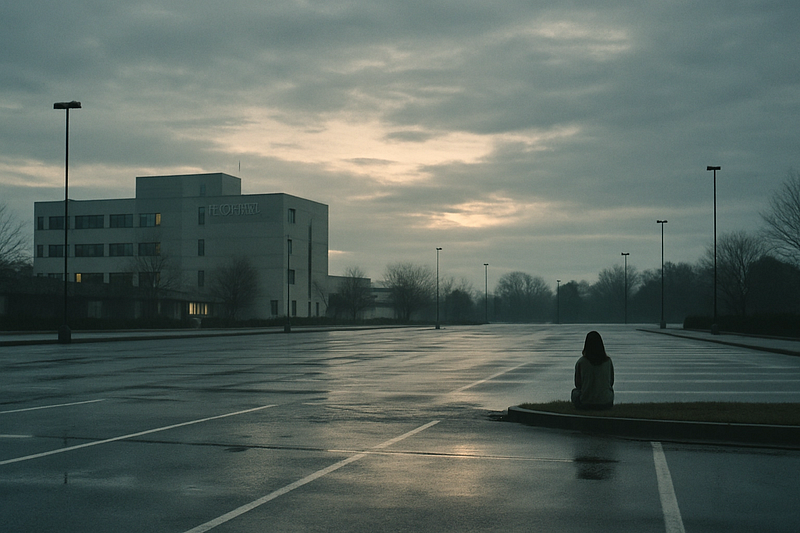
I left the hospital two days before Anthony walked through the door.
Effexor XR had cut through the depression the way SSRIs never could, and the Topamax still held me upright as a stabilizer. On paper, I was “better.”
In reality, I was in the soft, shaken stage that comes after a crisis — the part where your brain feels like wet clay and your emotions haven’t hardened back into anything you can lean on. Walking out of a psychiatric facility feels nothing like the movies. There’s no swell of music. There’s just the parking lot, and the daylight, and the strange sensation of being outside again while still not quite trusting your own legs.
The kids had been the anchor that pulled me out. Their visit had pierced through the fog and forced me to choose life. That’s why I got out. Not because the system saved me. Because I clawed my own way out.
When Anthony came home, I thought I’d finally get to breathe.
But the Army had other plans.
Typhoon Mel, Reporting for Duty
Within hours, I was told I had to fly back with him to Washington — to Fort Lewis, the same place where the breakdown had begun. Not because anyone thought travel was a good idea for someone freshly released from psychiatric care. Not because I was stable enough, or strong enough, or ready.
They wanted to talk to me about the Red Cross message that brought him home.
Not Anthony. Me.
They wanted proof.
And I understood why. I wasn’t an unknown spouse in their system. I was Typhoon Mel. The woman who had called in a congressional. The woman who fought until every soldier in the 513th was granted the leave they deserved. The woman who rattled the chain of command hard enough to leave dents.
They knew my name. They knew my fire. They knew I didn’t back down when people needed help.
So of course they wondered if the Red Cross message was another storm I was summoning.
But this wasn’t strategy. This wasn’t advocacy. This wasn’t Typhoon Mel on the warpath.
This was collapse.
And two days out of the hospital, fragile as tissue paper, I had to drag myself onto a plane and fly across the country to prove it.
The whole trip, my hands shook. Not from caffeine — I’d had one coffee, no extra shots — but from the chemical chaos of new meds, the emotional aftershock of hospitalization, and the terror of being forced back into the system that had helped break me.
The Commander

By the time we walked into the battalion commander’s office, I felt like a ghost wearing skin.
She scared the hell out of me.
She was a woman — formidable, battle-hardened in a way men rarely understand because they don’t have to fight the same battles just to be taken seriously. Her uniform was crisp, her posture carved from iron, her expression unreadable and lethal at the same time.
Not cruel. Just dangerously competent. The kind of woman who’d earned every ounce of authority, twice over.
She studied me with the sharp, assessing look of someone who had seen war, seen real suffering, seen people try to manipulate systems — and knew the difference between all of it.
And I was shaking like a leaf in front of her.
Not performing. Not strategizing. Just shaking.
Two days out of psychiatric care, raw, exhausted, barely held together by a handful of medications and maternal instinct.
I watched the shift happen. Her expression softened — a tiny change, barely visible unless you were looking for it. But I caught it. It wasn’t pity. It was recognition.
You don’t fake the kind of broken she was seeing.
She approved Anthony’s emergency leave without another question.
The Bright Spot in the Middle of the Storm
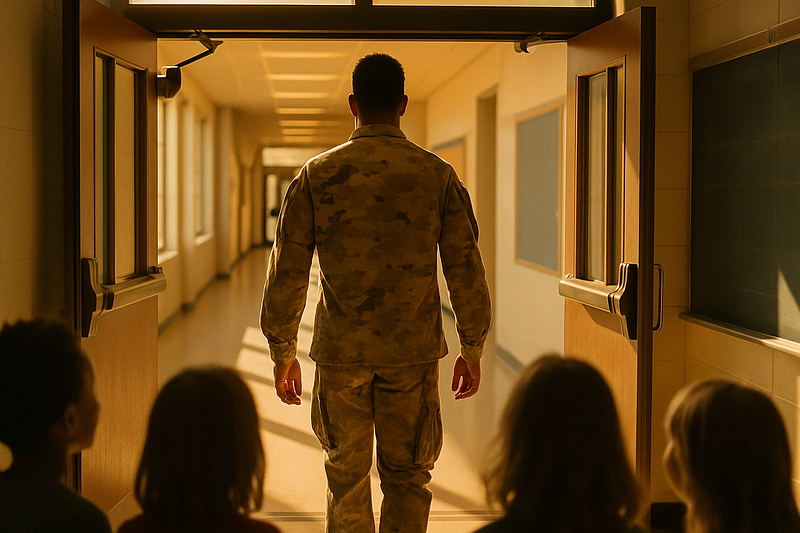
Those days after we got back to Kentucky, before he redeployed, are blurred at the edges. Trauma does that. But one moment shines with absolute clarity.
Anthony went to the kids’ school.
They had no idea he was coming. To them, Daddy was still in Iraq.
He walked into that building in full uniform — boots, blouse, patches, the weight of a deployment still clinging to him — and stepped into their classrooms like a hero out of a movie. He talked to the classes about what it meant to be a soldier. Where he’d been. Why he served. What it meant to come home.
And our kids —
God.
The way their faces lit up. The shock. The joy. The disbelief turning instantly into pride.
For a few minutes, they weren’t military kids shouldering the weight of absence and fear. They were the children whose dad came back from war and surprised their whole school.
That moment mattered. Because we didn’t get many bright moments then. Life didn’t hand them out generously. You took what you got and tried to hold onto it.
And that one? We held onto it.
Goodbyes That Hurt in Quiet Ways
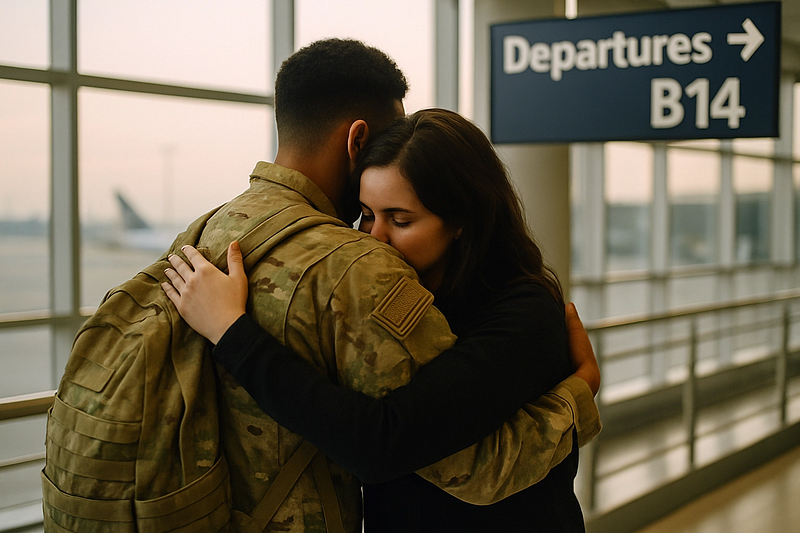
He got maybe a week. Maybe two. Time blurs around trauma. It wasn’t enough for healing. It wasn’t enough for reconnection. It was just enough time for me to shore myself up — patch the cracks, steady my breathing, try to make life feel normal for the kids — before the Army sent him back to Iraq.
There was no cinematic goodbye. No long, emotional scenes. Just the quiet fear of two people who knew exactly how fragile things still were.
He hugged me like someone praying I wouldn’t break once he was gone. I hugged him like someone terrified I might.
And then he was back on a plane to a war zone. And I was back in Kentucky with three kids, a bag of medications, and a life I had to keep running whether I was stable or not.
I didn’t get better because life paused for me.
I got better because life never did.
And I had no choice but to walk forward anyway.
Melanie Brown is the founder of Bluedobie Developing and the creator of DobieCore Learn, a system designed to help people communicate with AI without losing their human voice. This memoir, The Woods Behind Me, explores the years before the code — the seasons of fire and collapse that taught her how to build systems that actually hold.
Subscribe to follow the journey →
This is Chapter 13 of The Woods Behind Me, a serial memoir about surviving the military system, mental health collapse, and the slow work of building a life from the wreckage.
The Story So Far:
- Prologue: The First Crossing — Where the silence began.
- Chapter 12: The Roller Coaster— The previous chapter: Inside the psychiatric facility.
- Chapter 13: Back to Washington — You are here.
If this chapter resonated with you, I’d love to hear your thoughts in the comments. We don’t talk enough about the “shaken stage” that comes after a crisis — the part where you’re technically “better” but still feel like wet clay. Does that feel familiar to you?